

If you are a consultant, GP or senior trainee, someone has probably asked whether you would “do a report”. Expert witness work lets you use your clinical judgement outside the clinic, be paid for it, and set your own hours. It also carries duties most doctors were never taught. This article covers the benefits of expert witness training for doctors and what a medical expert witness in the UK gives up in return. For the mechanics of becoming one, read our complete guide for doctors.
TL;DR
- Demand is real: 14,428 new NHS clinical negligence claims and incidents in 2024/25, up 5%, and a reported shortage of trained medical experts.
- Pay is good but not guaranteed: the 2025 Bond Solon survey put the average report-writing rate at £238.81 an hour. Late payment was the most common complaint.
- The duties are personal: overriding duty to the court, a statement of truth on every report, no immunity from suit since 2011, and a GMC expectation that you take relevant training.
- Training turns the risk into a benefit: judges still criticise medical experts for straying outside their expertise and changing position without reason. Those are learnable failures.
Why doctors are asking this now
Three things are pushing doctors towards this work. The first is volume. NHS Resolution received 14,428 new clinical negligence claims and reported incidents in 2024/25, a 5% rise, and new claims under its main hospital scheme have passed their pre-pandemic peak. Coroners in England and Wales opened 36,700 inquests in 2024, and the GMC triaged 13,465 concerns about doctors in 2025, with 160 tribunal hearings. All of these need medical experts.
The second is scarcity. Medical Protection’s 2022 paper Getting it right when things go wrong said “many bodies (including courts and regulators) report difficulties in finding appropriately qualified individuals”, and named the barriers as time, unfamiliarity with the legal system and fear of criticism. Training addresses all three.
The third is that most of this work never reaches a courtroom. NHS Resolution resolved 83% of clinical claims in 2024/25 without court proceedings; only 24 went to trial. The job is mostly reading records and writing reports, so a defensible report is the core skill.
Benefit 1: a second income that scales with your time
There is no published scale for private expert work, so the best evidence is the annual Bond Solon survey with the Law Society Gazette. In 2025 it had 525 respondents, 71% from healthcare. The average hourly rate for report writing was £238.81: £253.73 in the civil courts, £227.41 in criminal and £209.60 in family. These are self-reported estimates.
Two cautions. Publicly funded work pays less; Legal Aid Agency rates for consultant-level criminal evidence run from the low £80s to £157 an hour (see the complete guide). And late payment was the most common complaint, cited by 188 of 525 experts. The BMA says you are “paid for the time it takes to formulate, present and discuss your evidence”, that you can negotiate terms rather than accept an agency’s standard rates, and that the work is not exempt from VAT.
Benefit 2: skills that feed back into clinical work
Experts in the 2025 Bond Solon survey said they most valued “the intellectual challenge”, and that the work “informs the way they do their own day job”. One medical respondent: “It makes me think in critical ways different to those in medicine.” Medical Protection adds that doctors who do expert work are “well-placed to conduct SI investigations and root cause analyses”, and that the variety may “improve job satisfaction and staff retention and prevent burnout”.
Benefit 3: protection, because the duties are yours alone
This is the benefit doctors underestimate. When you sign an expert report you take on duties that are personal, enforceable and public. Training exists to stop you breaching them without realising.
The duties you sign up to
- Duty to the court. Civil Procedure Rule 35.3: it is “the duty of experts to help the court on matters within their expertise”, and this “overrides any obligation to the person from whom experts have received instructions or by whom they are paid”. Practice Direction 35 adds that you “should not assume the role of an advocate”, must consider facts “which might detract from” your opinion, and must say when a question “falls outside their expertise”.
- Statement of truth. Every civil expert report confirms your opinions are “true and complete” and that you understand “proceedings for contempt of court may be brought” for a false statement.
- GMC standards. The GMC’s Providing witness statements or expert evidence as part of legal proceedings, in force from 30 January 2024, says experts “must have adequate knowledge of the current procedural requirements” and “should take part in relevant training to develop the practical knowledge and competencies required for the role” (paragraph 20).
- No immunity. In Jones v Kaney [2011] UKSC 13 the Supreme Court removed experts’ immunity from being sued for breach of duty in their evidence.
What happens when experts get it wrong
Judicial criticism of medical experts is published and searchable. A 2026 study in Medicine, Science and the Law reviewed judgments from September 2019 to August 2025 and found the same failings recurring: unclear reasoning, misuse of literature, inaccuracy, failure to keep up with the evidence, and disregard of instructions. In OAJ v Dorset County Hospitals [2025] an obstetric expert was criticised for straying outside their field. In Ebanks-Blake v Calder [2025] a defence expert’s evidence “lacked objectivity and balance” after he backed a colleague without reviewing the MRI images himself. In Conway v Yeovil [2025] the judge warned that unexplained “fundamental changes of position” will “significantly undermine an expert’s credibility”.
It can reach your registration too: in Kumar v GMC [2012] a doctor was suspended over deficient expert reports in a murder trial, and in GMC v Zafar [2020] a doctor sentenced for contempt over a dishonest report was erased. The 2025 cases involve ordinary clinicians who had not been taught where the lines are, and each criticism maps to a module on a decent course: scope of expertise, reasoning, handling a change of view, joint statements, cross-examination. Training does not make you immune; it makes you less likely to be the expert in the next judgment.
Benefit 4: credibility that brings instructions
Solicitors choose experts they can defend choosing. The Academy of Medical Royal Colleges’ 2019 guidance says experts should undertake specific training and keep it refreshed, and the GMC now expects the same. Experts agree: 71% of the 2025 Bond Solon respondents supported mandatory training and assessment. Training on your medico-legal CV, membership of the Expert Witness Institute or Academy of Experts, and an assessed qualification such as the University of Strathclyde Expert Witness Certificate all tell a solicitor the same thing: this doctor understands the role.
Benefit 5: flexibility and a longer career
Expert work is done mostly on your own time. Medical Protection describes it as “principally” home-based with rare court attendance. You can build it up alongside a full clinical job, scale it down in a hard year, and carry it into semi-retirement, provided you stay in or close to current practice, which instructing parties increasingly expect. It belongs in your appraisal portfolio, and the MPS paper recommends employers make time for it in job plans. If you are moving into governance roles, the skills overlap with our Medical Leadership and Management course, though that course does not cover medico-legal work.
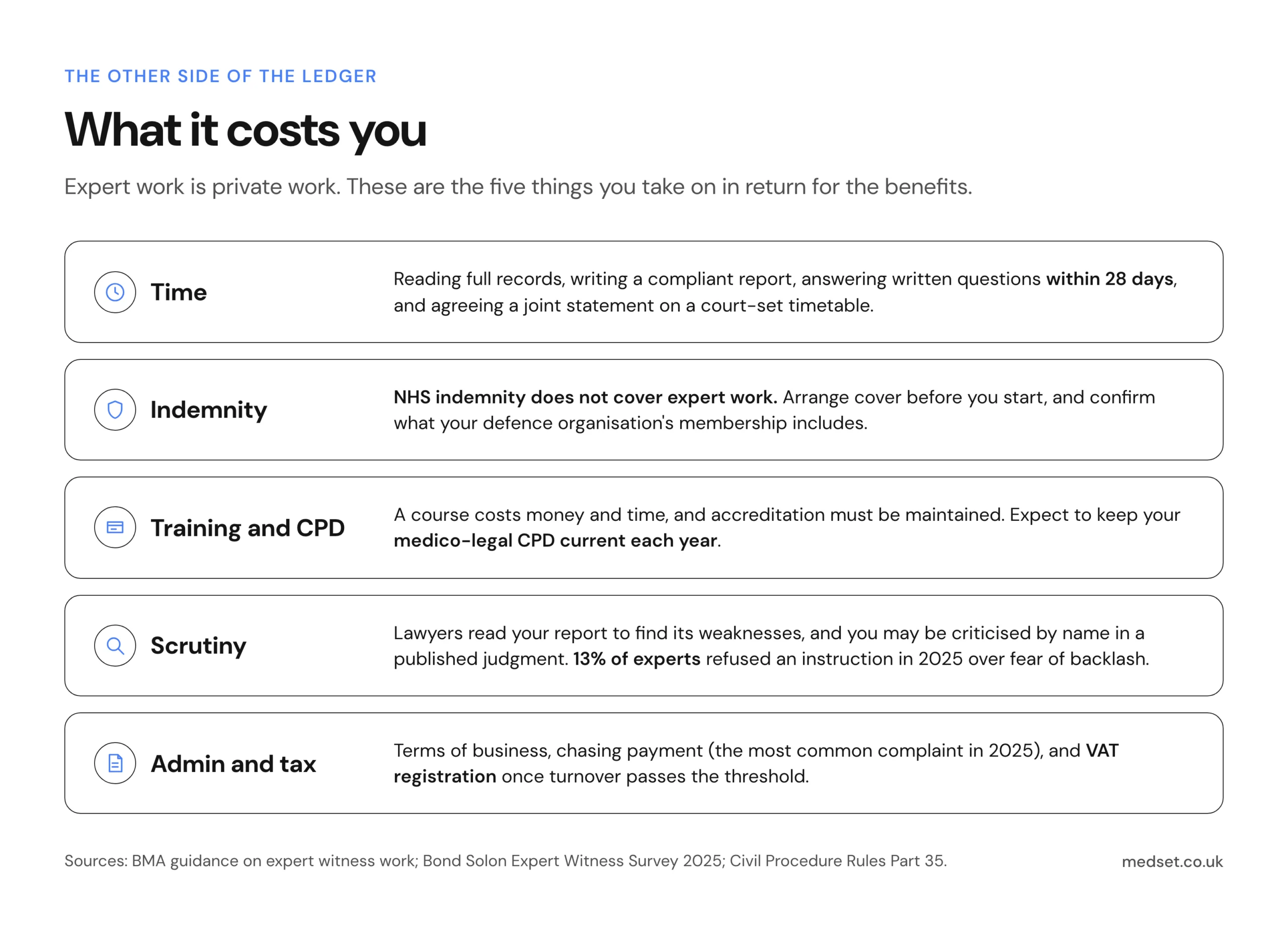
What it costs you
| Cost | What it means in practice |
|---|---|
| Time | Reading full records, writing a compliant report, answering written questions within 28 days, and agreeing a joint statement on a court-set timetable. The BMA’s first question is whether you “have sufficient time to deal with the case properly”. |
| Indemnity | NHS indemnity does not cover expert work. The BMA says to “take out appropriate insurance or professional indemnity cover before you start medico-legal work”. Confirm with your defence organisation what your membership includes. |
| Training and CPD | A course costs money and time, and accreditation must be maintained. Expect to keep your medico-legal CPD up to date each year. |
| Scrutiny | Lawyers read your report to find its weaknesses, and you may be criticised by name in a published judgment; 13% of experts in 2025 had refused an instruction over fear of backlash. |
| Admin and tax | Terms of business, chasing payment, and VAT registration once turnover passes the threshold. |
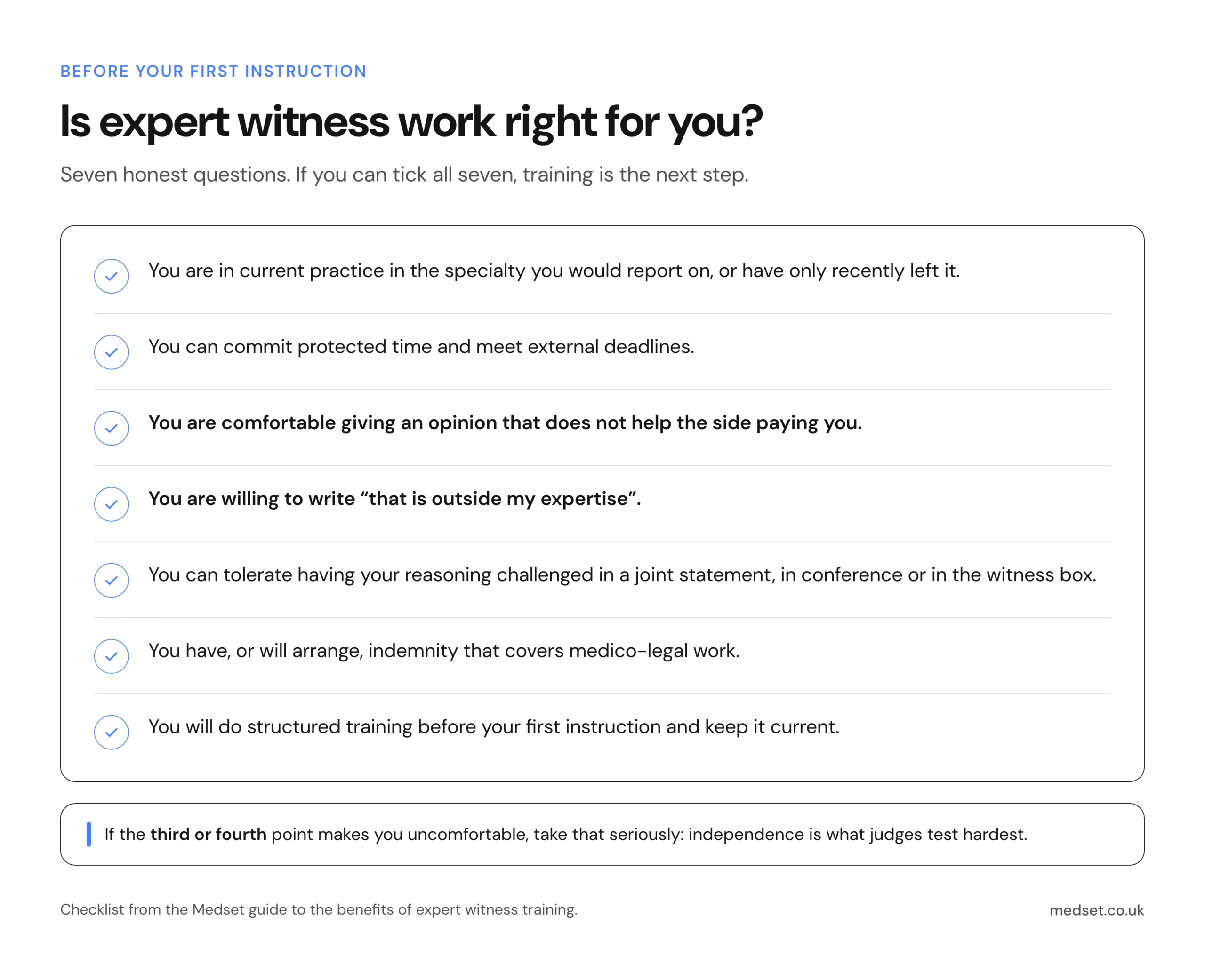
Is expert witness training for doctors right for you? A checklist
- You are in current practice in the specialty you would report on, or have only recently left it.
- You can commit protected time and meet external deadlines.
- You are comfortable giving an opinion that does not help the side paying you.
- You are willing to write “that is outside my expertise”.
- You can tolerate having your reasoning challenged in a joint statement, in conference or in the witness box.
- You have, or will arrange, indemnity that covers medico-legal work.
- You will do structured training before your first instruction and keep it current.
If the third or fourth point makes you uncomfortable, take that seriously: independence is what judges test hardest.
Where expert witness training for doctors fits, and what Medset offers
Every benefit above depends on knowing the rules before your first instruction, which is what expert witness training for doctors is for. Medset’s Medical Expert Witness Training, delivered with Inspire MediLaw, covers Part 35 and expert duties, report writing with feedback from a clinical negligence solicitor, meetings of experts, conference with counsel, and cross-examination. It runs as a self-paced online course (£1,140) or a two-day live course in Oxford (£1,675) with a mock cross-examination. Either route can be combined with the optional University of Strathclyde Expert Witness Certificate, assessed by a multiple-choice examination and a simulated cross-examination.
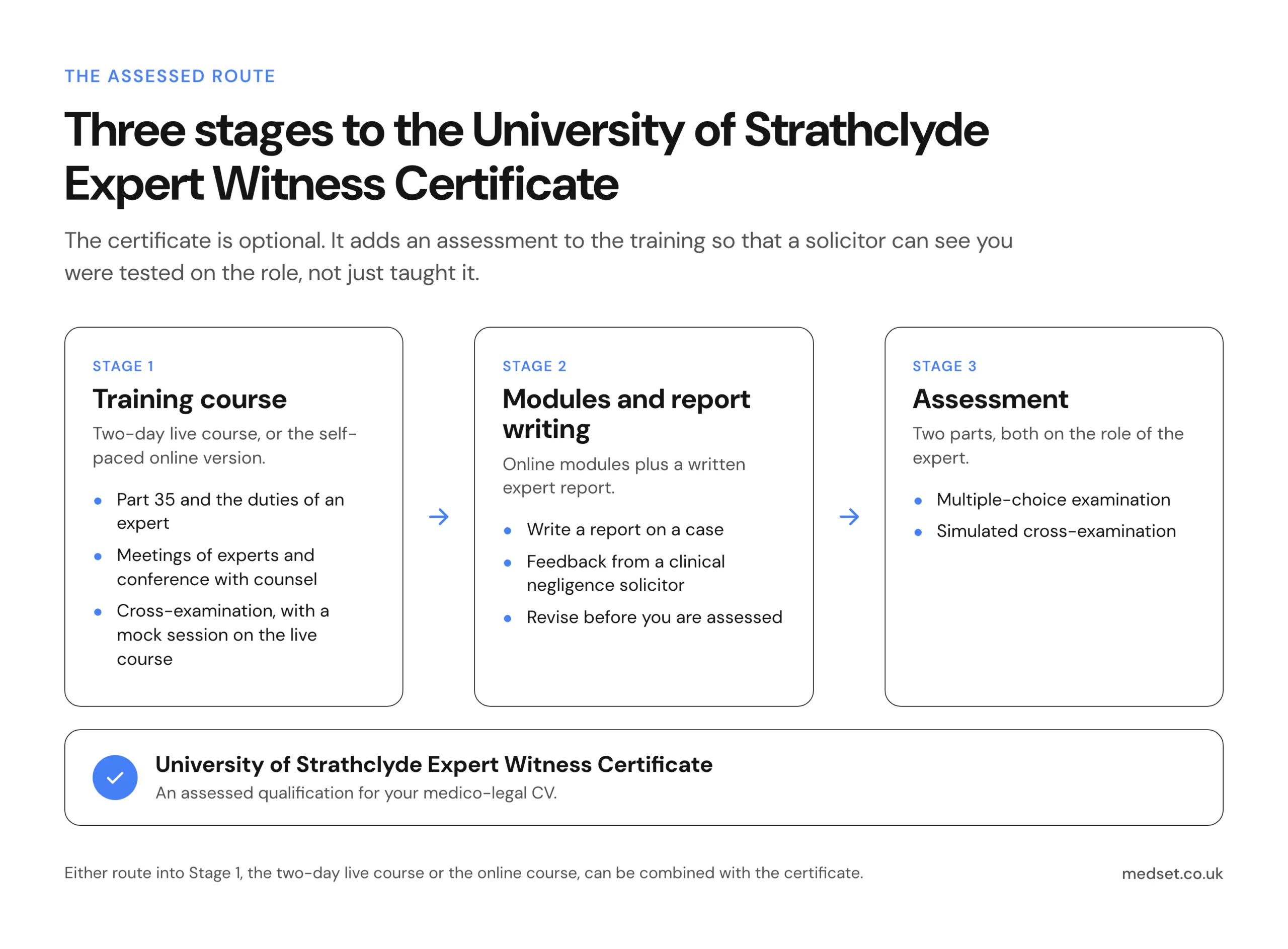
Neither is compulsory, and the complete guide lists other providers. But the doctors who get criticised are rarely the least qualified clinically; they are the ones who did not understand the job.
Frequently asked questions
Is expert witness training mandatory for doctors in the UK?
No. The court decides whether you are competent. But the GMC’s 2024 guidance says experts must know the procedural requirements and should take relevant training, the Academy of Medical Royal Colleges recommends specific training, and solicitors look for it on your CV.
How much can a doctor earn as an expert witness?
There is no fixed scale. The 2025 Bond Solon survey reported an average of £238.81 an hour for report writing (£253.73 in the civil courts). Legal aid rates are lower and late payment is common, so your terms of business matter as much as your rate.
Does my NHS indemnity cover expert witness work?
No. Expert work is private work and needs its own cover. The BMA advises arranging it before you start; confirm with your defence organisation what your membership includes.
Can I be sued or referred to the GMC over my expert evidence?
Yes to both. Since Jones v Kaney (2011) experts can be sued by their client for negligent evidence, and doctors have been suspended and erased over deficient or dishonest expert reports. Honest, well-reasoned evidence within your expertise is the protection.
What is the University of Strathclyde Expert Witness Certificate?
An optional, assessed qualification offered with Medset’s course and Inspire MediLaw: after the training you sit a multiple-choice examination and a simulated cross-examination, so solicitors can see you were assessed on the role.