Don't Let the Algorithms Fool You!
Navigating Negativity: A Guide for New Doctors
Despite their virtues, social media platforms by their inherent nature serve as echo chambers, and sensational and extreme content is favoured by their algorithms.
Because of this it’s important to recognise that this sensationalism often leans towards negativity. There is something compelling about negativity and complaints that tends to capture attention more than positive news and for this reason, negative news spreads rapidly on social media.
New foundation year doctors who are just starting and may feel overwhelmed by the negativity online should remember that they can navigate through it. You are more likely to encounter negative news, but countless individuals are having positive experiences that simply do not appear in your feed.
This same phenomenon occurs with internet reviews, particularly for experiences like restaurants. When you search for an average restaurant where you have enjoyed many meals, you will often find that the reviews are heavily skewed towards the negative. People who have had a pleasant experience are much less likely to leave a positive review compared to those who have had a negative experience.
So when scrolling, remember to keep this in mind and don’t let the algorithms fool you…
Weekly Prescription
“What horrifies me most is the idea of being useless: well educated, brilliantly promising, and fading out into an indifferent middle age” - Sylvia Plath
Do we still truly value brilliance in medicine? Or does Sylvia Plath’s proclamation now accurately describe medicine? With the introduction of the new randomised allocation system for foundation doctors, the latter seems increasingly plausible.
The Weight Lanyards Can Carry
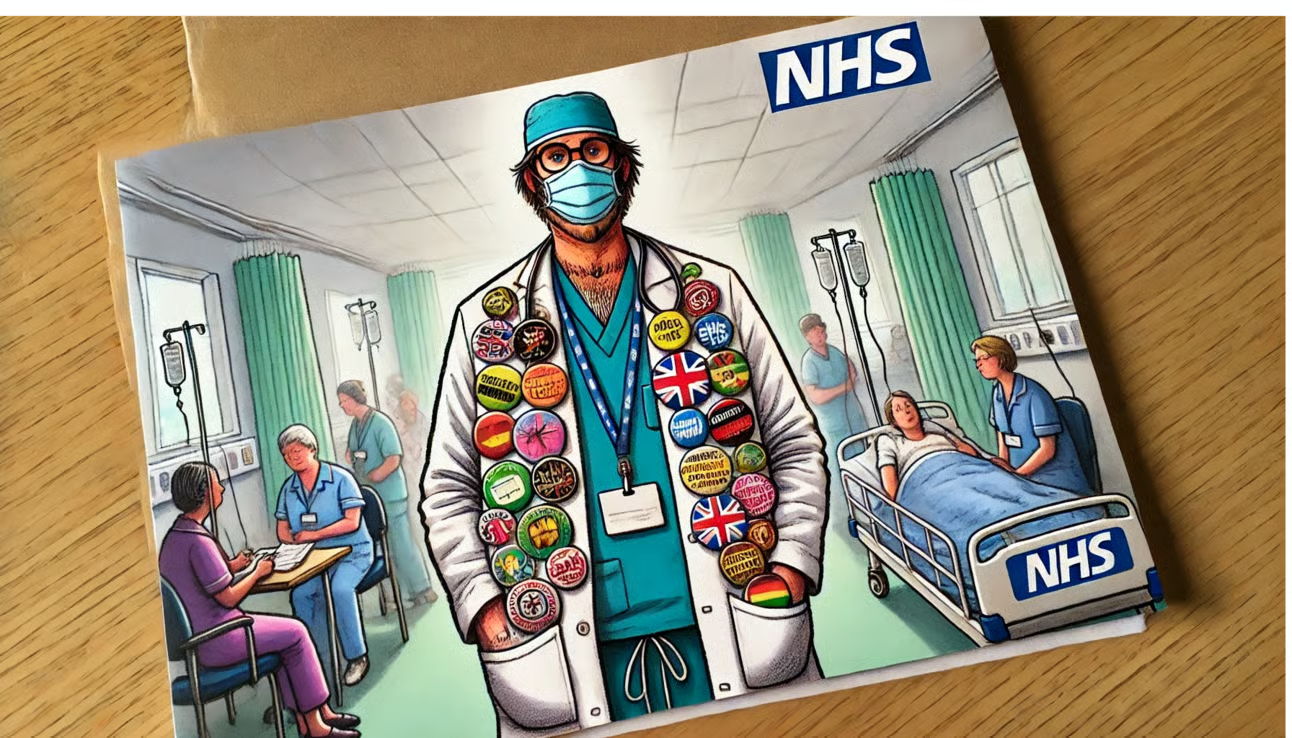
The humble hospital lanyard can show others more than just our ID badges…
Political messages are commonplace in the NHS and the tool of choice to convey these messages seems to be the hospital lanyard. Whether it’s the lanyard itself or a pin fastened upon it, these accessories have evolved into potent symbols of personal beliefs and affiliations and have extended far beyond their simple humble beginning of just holding an identification badge.
Walking through your average NHS ward, It is not uncommon to see lanyards plastered with slogans supporting various causes from pay equity to broader social issues encompassing geopolitical topics.
Whilst the lanyards themselves can’t speak, they can serve as powerful statements, subtly presenting the personal convictions of healthcare professionals into the literal fabric of their daily interactions. At its core, this raises fundamental questions about the nature of personal expression, professional identity and the ethical boundaries within which healthcare professionals operate.
The argument for wearing a lanyard of one’s choice is often based around individual autonomy and self-expression. However we know that the expression of this autonomy needs to be balanced against the perceptions and presence of other individuals.
Perhaps an outcome-based approach is more appropriate for examining this issue? If a political message fosters a positive work environment and enhances trust from patients, it should be permitted.
Conversely, if it leads to division, or a sense of distrust among patients or colleagues, then we should put it aside. The challenge lies in discerning which messages fall into which category, as there is clearly no objective standard.
What one person views as a universally acceptable message may not be seen the same way by another – a fact that is so true yet so easy to frequently forget.
With this in mind suddenly, the approach taken by some medical bodies to ban all political messages on lanyards begins to make more sense. This policy is often misunderstood as a renouncement of particular messages, but that is not the case.
The creation of this rule acknowledges that objective truth is rarely found in lanyard-worthy issues, which are often filled with nuance. Therefore, to prevent any damage to the doctor-patient relationship, blanket bans are imposed as a precautionary measure.
As private citizens, healthcare workers have the right to express their political beliefs freely. Yet, in their professional roles, it is perhaps right that we should be bound by ethical standards that prioritise patient welfare.
Board Round
A round-up of what’s on doctors’ minds
“The division it has created means we risk losing a further strike mandate and losing 4%”
“Seeing how stressed out the regs and consultants are constantly is making me realise I don’t want this long-term.”
“After just under 6 months of being a salaried GP I have today handed in my notice”
Referrals
Some things to review when you’re off the ward…
Weekly Poll
Should doctors be allowed to openly support any cause that they want whilst at work?
…and whilst you’re here, can we please take a quick history from you?
STAT Note
Don’t Overpay National Insurance!
There are doctors in the On-Call community undertaking locum work who could potentially be overpaying national insurance.
If you already have a salary above £50,270pa, then you should be paying 2% national insurance on any additional employment income you receive, say through locums.
Doctors may sometimes see 12.5% national insurance erroneously taken off their locum pay, especially if they work at a separate trust- watch out for this one!
Share the News. Build the Community.
Help us build a community for doctors like you. Subscribe & Share On-Call News with a friend or colleague!
*We’ve done our best to keep this information accurate, but person specifications can change. Always check the latest person specification for your training programme before relying on this information.
Disclaimer:
Content in the On Call Newsletter reflects the personal views of individual authors and does not represent the views, policies or guidance of Medset Ltd. Articles are for general information only and do not constitute clinical or professional advice. Medset Ltd accepts no liability for decisions made based on this content.