Private Healthcare, Harley Street Scans, and the Cost of Marginal Gains
The divide between affordability and aspiration
In the world of medicine, statistics often tell a story, and the latest from the UK healthcare landscape is worth noting: a record-breaking 230,000 private hospital admissions in the second quarter of 2024. Most of these private admissions (164,000) were funded by private medical insurance. What are these patients lining up for in the private sector? Not just the predictable cataract surgeries (the most common private procedure), but an eye-opening surge in chemotherapy, which has seen a 17% increase—the steepest rise for any procedure.
These numbers are loud and clear: patients, especially those with serious conditions, are voting with their wallets. Or rather, with their insurance policies. But this brings us to an awkward question: what are they buying when they pay for private care? Sometimes, it seems, they’re buying ease of access or even peace of mind. Other times, they might just be buying more scans.
John Launer, GP and writer, shared a personal story that illustrates the nuance (and occasional absurdity) of the private healthcare ecosystem. Needing a root canal, he sought an opinion on Harley Street, where a dentist advised fancy imaging and treatment that would have cost a small fortune. A second opinion, in less glamorous surroundings, halved the cost and skipped the fancy imaging.
So, was the Harley Street dentist a greedy villain? Not necessarily. It’s easy to sneer at the gold-plated offerings of high-end private practitioners, but there’s more to the story. At the top of the private sector, there’s an obsession with minimising risk and optimising outcomes. If a scan reduces the chance of complications from 10% to 8%, some patients (especially the wealthy ones) will pay any price for that marginal gain.
The problem? Nobody told Launer why the extra scans were being pushed. The rationale: improving outcomes by a smidge—was left for the patient to deduce. Transparency, it seems, is a rare commodity in private healthcare, even when the procedures aren’t.
Launer’s experience reveals a tension at the heart of private medicine: the pursuit of perfection for the few vs. good-enough care for the many. The ultra-wealthy, willing to pay for every conceivable improvement, are shaping what’s offered. But what happens when this mindset spreads to other areas of medicine? If private healthcare becomes about squeezing out tiny improvements at massive costs, what happens to treatments that are affordable, effective, and equitable?
Weekly Prescription
The Humble Hurdle: Times To Be Careful
Senior consultants often say that the moments they worry most about juniors aren’t during emergencies but at transition points: stepping into F1, CT1, Registrar, or even Consultant roles. These are the times when shiny new titles and badges outshine the lived experience that hasn’t yet been earned.
It’s not about lacking ability—it’s about lacking humility. At these stages, we’ve not yet been “humbled” by the inevitable missteps that teach us medicine’s toughest lessons. It’s hard to admit you’re back at the bottom of the ladder when you’ve been the pride of the deanery or ranked 2nd nationally for your application. But as any experienced doctor will tell you, CT1/ST1-itis (a well-documented affliction) can affect judgment.
So, at every transition, remember to keep your eyes wide open and your ego in check.
A Tale of Two Payments: Student Loans and the Doctor’s Dilemma
The rise of student debt and what it means for doctors…
In 1990, when the student loan company was founded, the average loan was £390 a year to help with living costs. Fast forward to today, and graduates are leaving university with debts totalling tens of thousands of pounds. That’s the price of a decent car or a deposit on a home—but instead, it’s spent on ramen noodles, a sack of heavy textbooks, photocopying, and a medicine degree.
The Institute for Fiscal Studies (IFS) reminds us that a staggering 83% of graduates won’t repay their loans in full. Why? Because the interest often grows faster than they can chip away at it. But here’s the twist: for doctors and other high earners, that loan might actually be repaid in full. Should that fill us with dread or delight?
The repayment system for student loans is progressive, pegged at 9% of earnings above a threshold—£27,295 for Plan 2 loans. That means the more you earn, the more you repay. Financial guru Martin Lewis points out an ironic comfort in this: if you’re paying off your loan in full, you must be earning well enough to do so. In essence, you’re winning at life (and taxes).
Doctors, particularly those who reach consultant positions, often fall within the lucky/unlucky 13% who repay their loans entirely. For these high earners, overpaying the loan might seem like a savvy move to avoid interest and could save you thousands in the long run—but there’s a catch.
Student Finance operates a one-way street. Once you make an overpayment, that cash is gone. No refunds, no take-backsies. Before throwing extra cash at your loan, consider whether that money could be better used elsewhere—say, for a house deposit or a stocks and shares ISA. At least those options let you access your money if circumstances change.
The IFS crunched the numbers and came to a reassuring conclusion: university remains a solid investment. Men are, on average, £130,000 better off over their lifetimes after taxes and loan repayments. For women, it’s £100,000. The message is clear: the long-term financial benefits of higher education still outweigh the short-term financial pain.
Doctors, in particular, embody this return on investment. Your education didn’t just land you a job—it gave you a career that puts you among the top earners who will repay their loans. That fact alone proves the value of the system, even if it doesn’t always feel like it when the deductions hit your paycheck.
Board Round
A round-up of what’s on doctors’ minds
“I hate how normalised ?sepsis (chest vs urine) has become. Of course, there must famously not be any other sources of infection”
“I should probably report myself to the GMC for “fitness to practice” every exam season, based solely on the state of my house”
“Not sure where I read it, but another line that stuck with me is that the only people who will remember how hard you worked are your family. Keep that in mind when deciding how you choose to spend your time”
Referrals
Some things to review when you’re off the ward…
Weekly Poll
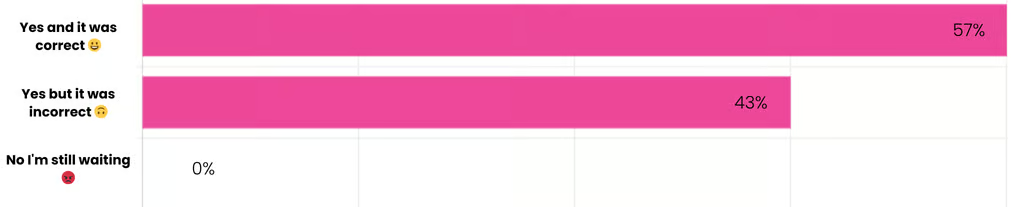
Have you received your backpay?
…and whilst you’re here, can we please take a quick history from you?
STAT Note
It’s rotation time, and many of our junior colleagues are experiencing what can only be termed changeover anxiety. For those leaving a supportive team behind, the prospect of starting over can feel sad and daunting. (If you’ve just survived four months of hell, please take your finishing party elsewhere for a moment—we’ll join you later)
No one really prepares us for this side of a medical career: the perpetual goodbyes. Just as you’ve figured out how the team works, learned the consultant’s quirks, and bonded over midnight snacks, it’s time to pack up and move on. For a profession built on the impermanence of life, you’d think we’d be better at transitions. Spoiler: we’re not.
The silver lining is that every goodbye makes room for growth, new connections, and another team that just might surprise you.
Share the News. Build the Community.
Help us build a community for doctors like you. Subscribe & Share On-Call News with a friend or colleague!
*We’ve done our best to keep this information accurate, but person specifications can change. Always check the latest person specification for your training programme before relying on this information.
Disclaimer:
Content in the On Call Newsletter reflects the personal views of individual authors and does not represent the views, policies or guidance of Medset Ltd. Articles are for general information only and do not constitute clinical or professional advice. Medset Ltd accepts no liability for decisions made based on this content.