Is the MSRA the Only Thing Guarding Against Portfolio Inflation?
Although unpopular, is this exam saving us from something even worse?
Let us start with a statement that should be uncontested: No exam is perfect. On-Call community, reflect on the trajectory of your own career, from the stress of GCSEs to the high-stakes nature of OSCEs.
Can you recall a single assessment that escaped your criticism? The MSRA is no exception. It consistently summons the deepest frustrations from our community of doctors, yet it remains the gatekeeper for an ever-growing list of specialities. In this piece, we ask, if we were to move away from it, what are the genuine alternatives?
The Portfolio Approach
One alternative is to shift the weighting toward a portfolio or increase its comprehensiveness. Proponents argue that a portfolio offers a longitudinal view of a doctor’s competence rather than a couple-hour snapshot that is provided by an exam, where heart rates and anxiety are sky high.
However, the shift in recent years has actually been away from heavy portfolios due to concerns regarding inter-rater reliability and the administrative burden on consultants as applicants continue to trend upwards.
The trend is clear. Clinical Radiology significantly streamlined its self-assessment (from a portfolio carrying 45 points to 24), and several specialties including Psychiatry and GP, do not use a scored portfolio at all for initial shortlisting. While IMT, Ophthalmology, and Paediatrics still demand significant portfolio evidence, the lack of a portfolio requirement in other fields has led to accusations that we are devaluing speciality commitment.
One consideration of a portfolio, however, would be what we will term ‘portfolio inflation’. A system that demands an extensive list of publications and audits naturally selects for those who take F3 or F4 years. We risk creating a bottleneck where jumping straight from F2 into training becomes statistically impossible.
Speciality Specific Exams
A frequent criticism of the MSRA and its questions is its perceived lack of relevance to the actual job doctors are applying for. Originally designed for General Practice, the MSRA tests a broad but superficial range of clinical knowledge via short stems, followed by a fifty per cent weighting on Situational Judgement.
These short question stems reward a specific type of cognitive shorthand. It encourages candidates to prioritise speed and superficial breadth, rather than the cultivation of deep clinical reasoning.
It’s almost as if the powers that be are happy to inadvertently condition a generation of ST1 doctors to favour rapid-fire heuristics over nuanced reasoning.
Many argue that an Anaesthetics or Radiology applicant should not be judged on their ability to manage a GP-level paediatric rash. But, is it right to expect speciality-specific knowledge before the training begins? The primary goal of the first year of training is the acquisition of that knowledge. An entrance exam is often designed to test general clinical reasoning and trainability rather than mastery of a niche.
Weekly Prescription
The “Clinical Correlation Advised” Love-Hate Relationship
The Teleradiology company Hexarad recently interviewed a General Surgery Consultant, asking him what his least favourite Rad-phrase is. His response was the omnipresent “Clinical Correlation Recommended”. To him, this was a reminder to do something that they are already doing.
But is this the sole purpose of the phrase when radiologists use it? Perhaps not. If a radiologist is looking at a CT KUB for a kidney stone and finds fat stranding around the appendix instead, “clinical correlation advised” could be a polite way of saying: “I think the ‘loin pain’ you described is actually in the Right Iliac Fossa. Can you double-check the patient?”
It’s hard to give a definitive answer when the request just says “acute surgical abdo.” Radiologists are trying to connect the dots, but they are often missing half of them. If doctors want to see the back of generic disclaimers like “Clinical Correlation Advised”, we probably need to see the back of one-line referrals, too.
What Happens Now That UK Grads Have the Home Advantage?
Will the Medical Training (Prioritisation) Bill make a difference to you?
The story of the hour for resident doctors is the swift movement of the Medical Training (Prioritisation) Bill. As of the end of February, the Bill has cleared its three major hurdles in the House of Lords and finds itself waiting for Royal Assent. Despite significant lobbying from some lords to delay implementation until the 2027 cycle, the bill has survived unscathed and will apply to this year’s application cycle.
With Royal Assent expected imminently, likely by March 5th, the rules of the game are changing mid-cycle. But what does this mean for the individual doctor awaiting Oriel notifications? Because the impact is far from the same. It depends entirely on your chosen speciality.
The Anaesthetics Status Quo
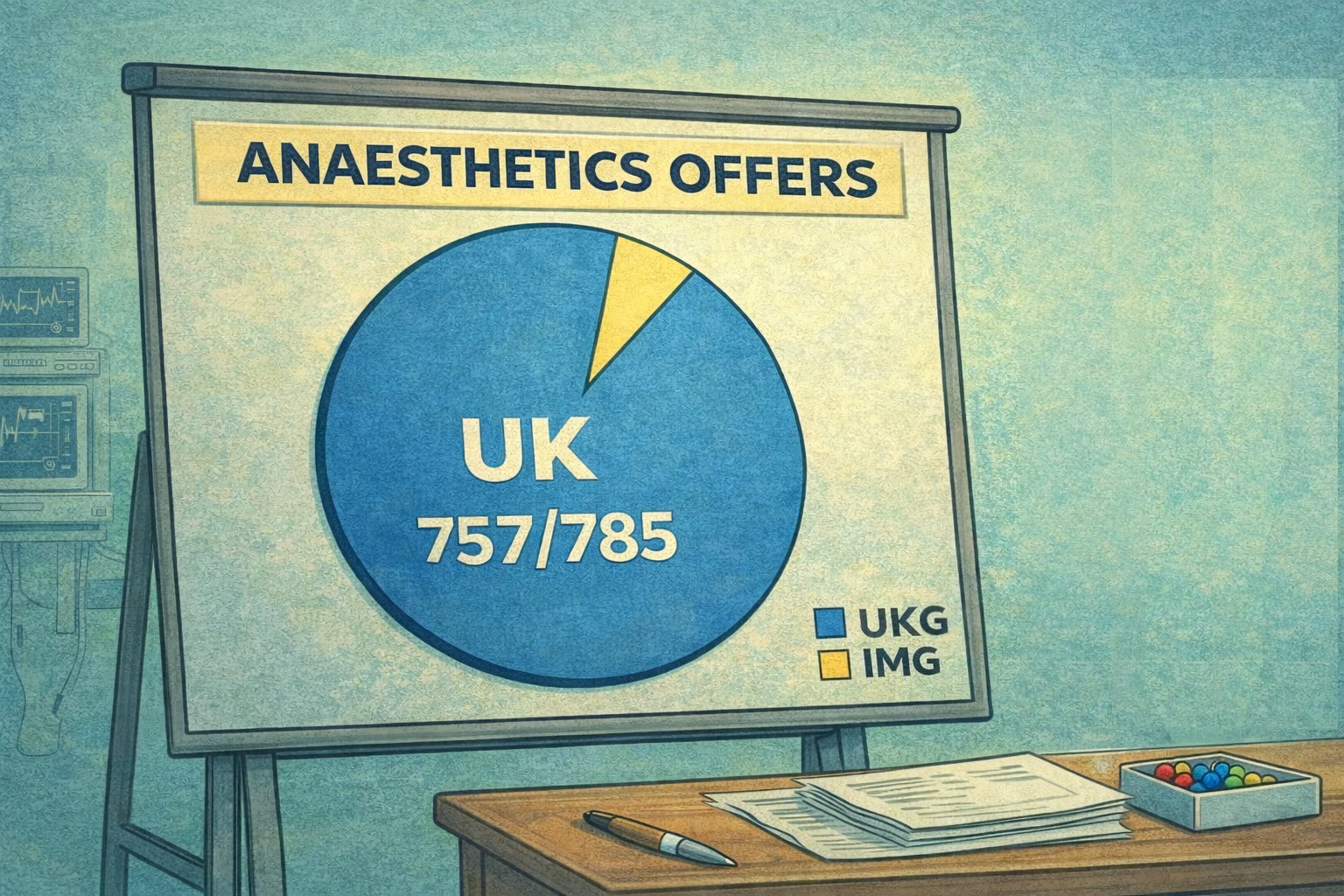
For those dreaming of a career in Anaesthetics, the new bill looks like nothing to write home about. In this article, we are using the 2024 NHS England recruitment data, which shows that in anaesthetics, the speciality is already heavily dominated by home-grown talent at the offer stage.
5,756 was the total number of applicants, with approx. 56% IMGs. On the other side of the application process, only 28 of the 785 offers went to IMGs. A measly 3.57%. The heavy weighting given to the MSRA and interview process is highly effective in selecting for a UK-trained cohort. As a result, the bill will likely not change the chances of acquiring an anaesthetic post for UK graduates.
The IMT Battleground
Compare this to Internal Medical Training (IMT), where the landscape shifts dramatically. Historically, IMGs have acquired a significant number of Internal Medicine Training posts. In the 2024 data, IMGs secured roughly 36.5% of all IMT offers. For a UK grad with a mid-range rank who might have previously been pipped by a high-scoring IMG, this bill is a golden ticket to a preferred deanery.
IMG Contingency Plans
Online communities for international medical graduates are already discussing potential contingency plans. Some are suggesting a shift in focus from the traditional pathway of sitting the PLAB exam, toward securing professional memberships early, such as completing the Royal College exams and looking for secure employment in their home countries.
For the domestic graduate, the 2026 cycle represents a significant increase in the probability of securing a preferred deanery, however, the size of your advantage very much depends on the speciality of your choice.
Once again, here is the full list of data from the 2024 cycle, so you can see what kind of an advantage UK grads may get in your specialty.
Board Round
A round-up of what’s on doctors’ minds
“Hearing some heartbreaking post-MSRA stories online from doctors who have received brilliant scores that would have been good enough in any previous year. Hope all you guys know that this is not the end of your careers by any stretch of the imagination. Get out there, speak to senior colleagues who have had to take extended routes and realise how common (and possible) it is.”
“So now we just have the small task of ensuring the oriel gods implement UKGP accurately before releasing offers – my money is on a mess up and delayed offers.”
“What am I to do with the referral: Medics to examine to r/o pathology”
“As a UK grad, it is difficult not to feel empathetic for the IMGs who have spent significant money and time on their portfolios for this cycle.”
Referrals
Some things to review when you’re off the ward…
The Plan 2 student loan interest rates mean that someone who has an average £53,000 student debt has to earn about £66,000 before their repayments are greater than the interest being added. The higher the debt (as is the case for many medics), the more you need to earn to begin clearing it. Additionally, frozen loan repayment thresholds by the Chancellor only serve to take more money from our pockets. Here is the full piece from The Times.
A report from the Guardian last week revealed that almost half of the public delay or outright avoid contacting their GP when they are ill. The main reason for this is the belief that they will struggle to get an appointment. What can we do to tackle the issue that is getting to the front door of the health service?
Weekly Poll
Should doctors be incentivised (financially or career-wise) to work in underserved coastal/rural areas?
…and whilst you’re here, can we please take a quick history from you?
STAT Note
“The (Additional) Costs of Being Single As A Doctor”
People usually think that the only downside to being single is having to explain your dating life at Christmas, but what about the economics of it all? A piece from the guys at Financial Interest broke down some key figures on why it is so expensive to be single in the UK. Let’s see what they found:
Single people spend, on average, around £8,000 more per year on essentials than couples (per person). This includes energy bills, council tax and food. In fact, Financial Interest found that the only area singletons come out on top is transport, where they spend 14% less compared to a couple per person, which they perhaps attributed to couples going out more (or maybe having the disposable income to afford to do so).
In London, living alone can absorb up to 80% of disposable income for someone on the UK’s median wage. We know that being single doesn’t necessarily mean living by yourself, as many single adults live with parents or housemates to maintain affordability. But one-person households are more common in the UK than you may think…
There are 28.6 million homes in the UK, and around 30% are occupied by a single person according to the ONS. It should be no surprise to readers that more young adults than ever are living with parents (10% more than in 2014), but whilst that may mean some extra years of unsolicited life advice, it can also be the catalyst for boosting net financial wealth. 14% of young adults living with parents boost their net financial wealth by over £10,000 over a two-year period.
Share the News. Build the Community.
Help us build a community for doctors like you. Subscribe & Share On-Call News with a friend or colleague!
*We’ve done our best to keep this information accurate, but person specifications can change. Always check the latest person specification for your training programme before relying on this information.
Disclaimer:
Content in the On Call Newsletter reflects the personal views of individual authors and does not represent the views, policies or guidance of Medset Ltd. Articles are for general information only and do not constitute clinical or professional advice. Medset Ltd accepts no liability for decisions made based on this content.