247 candidates have put themselves forward to fill the 69 seats on the BMA UK Council, tasked with representing doctors across the country for the next three years. In principle, this is a healthy sign and shows a profession engaged, opinionated, and willing to participate in its own governance. In practice, however, the structure of the election (and the environment forming around it) raises more complicated questions about what “representation” now means.
The BMA’s electoral framework divides representation into three categories. Forty seats are allocated geographically, with most regions containing three representatives and London four. A further 24 seats are distributed across “Branches of Practice”, such as academia, the armed forces, general practice, and so on. Finally, five seats are reserved for ethnic minority representatives, requiring candidates to self-identify as Black, Asian, or from another minority background.
Most members will by now have received the huge pamphlet of candidate manifestos through the post. Few will have read it in full. Jokes aside, this is not so much a criticism but rather a reality: the demands of our jobs leave limited time for politics. Into this vacuum step organised interest groups, offering curated lists of “recommended” candidates.
Such groups are not new. Politics has always relied on intermediaries to reduce complexity. But their growing prevalence introduces two distinct risks…
One risk that these interest groups bring is epistemic outsourcing. Faced with an overwhelming number of candidates, voters may defer entirely to the recommendations of groups whose internal decision-making processes may not be too obvious. The act of voting becomes less an exercise in judgment and reasoning and more an act of alignment.
Second, and perhaps more consequential, is the reduction of politics to single-issue affiliation. When candidates are endorsed primarily because of one policy (e.g. pay restoration, IMG advocacy, training reform), broader questions of governance get demoted into the background.
Take, for instance, the grassroots organisation DoctorsTogether, which has lobbied around the demand for full pay restoration. It presents a list of recommended candidates, many of whom appear linked to earlier groups such as DoctorsVote and Doctors United. Alongside this, IMG Voice has produced its own list of candidates focused on representing international medical graduates.
Individually, these movements are understandable responses to perceived deficits in representation. Collectively, however, they begin to reshape the electoral landscape into something far more segmented: less a place for deliberation across the profession, and more a competition between already organised camps.
At this point, there may be some readers advocating for reassurance as they proclaim that this is simply democracy in action. Yet there is a deeper issue here, one that political theorists have long recognised.
Alexis de Tocqueville warned that democratic systems risk collapsing into a “tyranny of the majority,” not necessarily through coercion, but through the dominance of prevailing sentiments. In a modern professional context, this may not manifest as a single majority, but as a coalition of organised blocs. Ultimately, democracy is about difficult decisions in an attempt to arrive at what is the ‘right thing to do’, even if it comes at personal cost on the individual level.
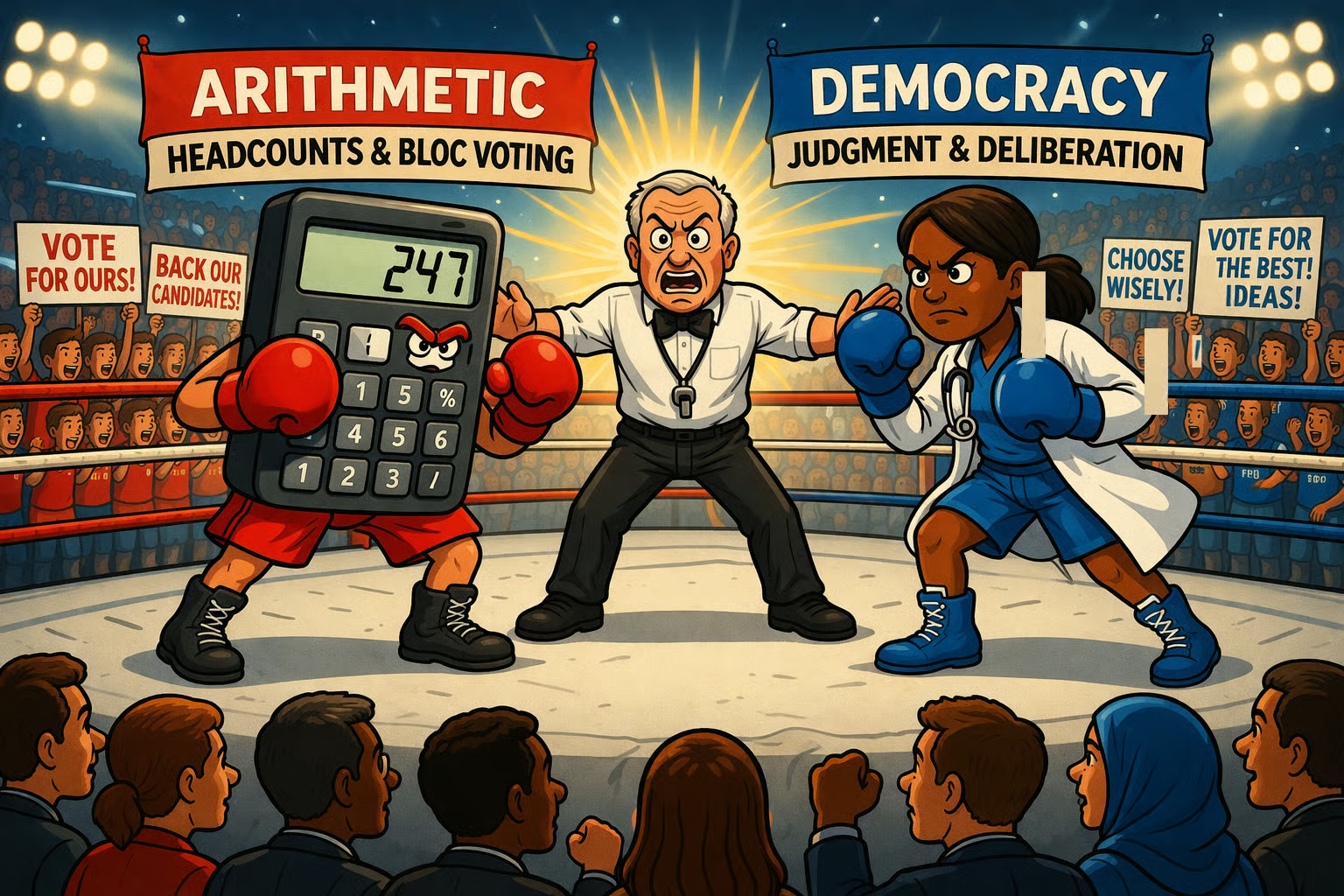
And this is perhaps the central risk: that democracy, particularly in complex professional bodies, becomes less about judgment and more about arithmetic and numbers. A headcount of aligned interests rather than a contest of competing ideas.
None of this is to suggest that interest groups should not exist, or that identity and experience should not inform representation. They inevitably will. But if voting becomes synonymous with bloc affiliation and if we cease to ask what kind of representatives we want, beyond what they promise on a single issue, then we risk removing the essence of what democracy should be about, exercising judgment even if it comes at a personal cost.
The challenge is not how to eliminate factions, but how to resist becoming entirely defined by them. Because once democracy is reduced to a headcount, it may entirely change in character.
How much time do we waste every day in the NHS trying to communicate, but falling short either because we didn’t reach the right provider, or have to search endlessly for the information we need? We bleep the wrong numbers, dig through induction apps and send wrong referral forms.
It wouldn’t be too dramatic to say that some hospitals and specialities operate following a “bleep-and-wait” lottery. You dial the number and hope the user on the other end of the line is available to call you back. If we want to make the productivity gains that we need in the NHS, clawing back lost time from our faulty communication systems could be the best place to start for trusts across the country.
Take Norfolk and Norwich University Hospitals, which introduced the Alertive Platform and reduced the time to communicate pathology results from an average of 54 minutes via bleep to 4 minutes via a digital messaging service. Many trusts from Guys and St. Thomas’ to South Tees Hospital have also been utilising Smartpage, where doctors are provided phones whilst on-call or on nights where they receive jobs through text format on the app. This allows them to triage appropriately and ask clinical questions back through to the nursing team.
These are just some of the methods we regain control of our time in the NHS.
Sponsored
Perhaps Medset’s Train the Trainers and Leadership & Management courses might be the answers you were looking for…
Online and Live Virtual Classroom options available – use code ONCALL10 for a 10% discount.
Check whether your speciality awards extra application points with our 12 CPD-accredited Train The Trainers course*
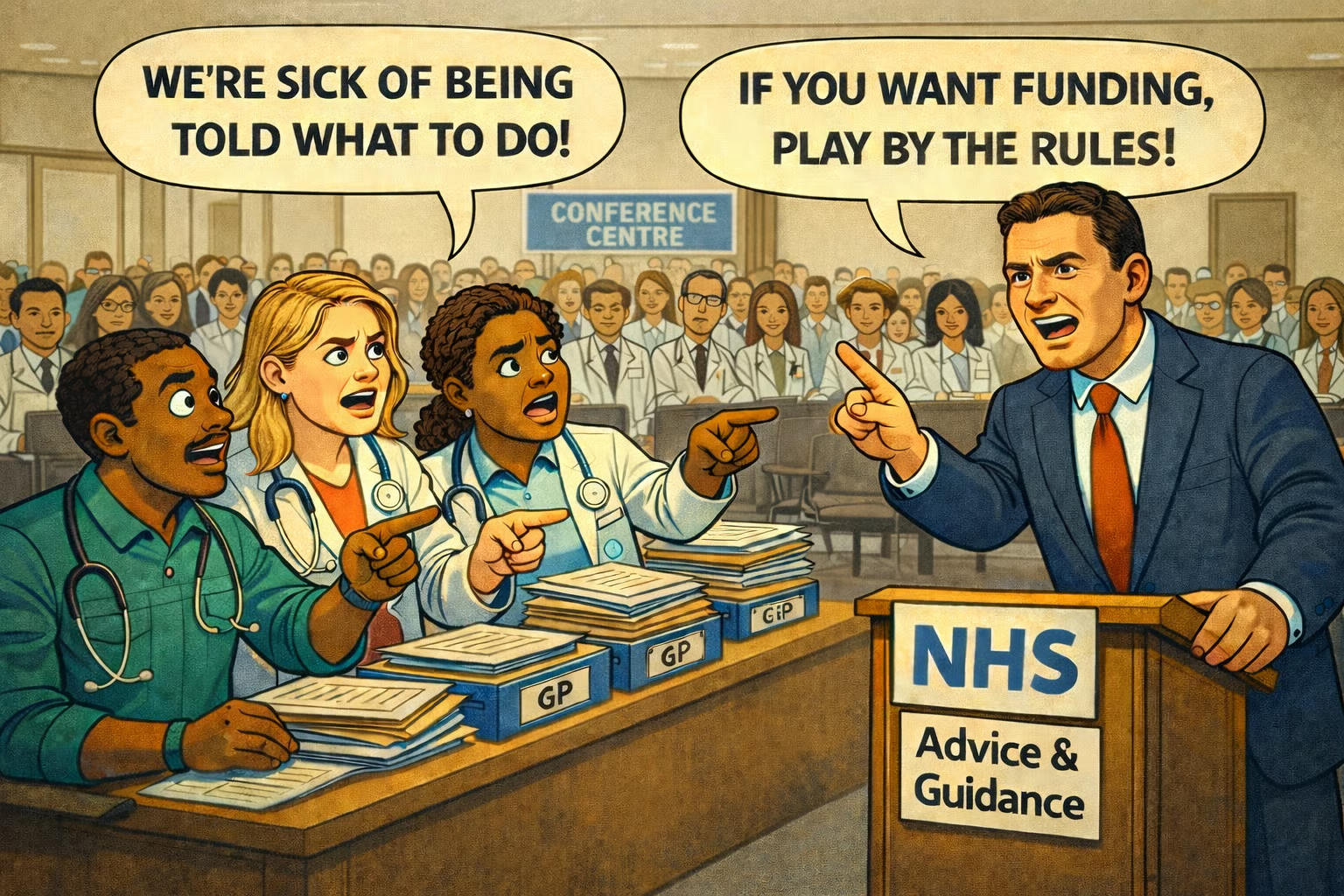
Given the structure of our health system, when changes hit general practice, the whole NHS feels the effects. NHS England will be hoping the recent changes to the Advice and Guidance (A&G) system leave the profession in a better state. Why is it, then, that doctors who have made a name for themselves in the media, such as Dr. Amir Khan, have been in front of cameras expressing frustration at a system they fear will curtail GP power and autonomy?
As the government scrambles to dismantle unprecedented waiting lists, A&G has been positioned as a primary tool for reform. The process is straightforward: before a GP can refer a patient to a hospital, they are now required to seek advice from a specialist first.
These requests are submitted electronically and reviewed remotely by hospital clinicians. The specialist then decides the next step: should the patient be added to the elective waiting list, or can the GP manage them in the community with a specific plan of tests and treatments?
While A&G has existed in some form since 2015, the “fuss” today stems from a major contractual shift. Under the 2025 contract, A&G was an “enhanced service”—an optional choice that came with additional funding. However, under the new 2026/27 contract, it has become a mandatory requirement. GPs are now contractually obliged to use A&G prior to, or instead of, a referral whenever “clinically appropriate.”
The intention behind the rollout is clear: reduce “unnecessary” referrals and ensure patients receive care in their own communities rather than languishing on a six-month elective list. From a patient’s perspective, getting a specialist’s answer via their GP in 48 hours is infinitely better than waiting half a year just to be told the same thing in a consultant’s office.
However, for GPs, this feels like a direct hit to their professional autonomy. Many feel the policy transforms them from independent clinicians into administrative “gatekeepers” who must now ask for a consultant’s permission before a patient can even join a queue.
Furthermore, there is the issue of “workload shift.” While A&G successfully keeps a patient off the hospital’s books, that patient remains on the GP’s list. When a consultant suggests “more tests” via an A&G message, it is the GP—already stretched to the limit—who must order the labs, chase the results, and coordinate with the patient. Without the administrative backbone that hospitals enjoy, many GPs feel they are being asked to do the hospital’s work without the hospital’s resources.
A round-up of what’s on doctors’ minds
“Part of me is pessimistic about whether any political party will have the political will to address the £100,000 tax trap. It seems to address it, one has to either cut taxes for the well-off (e.g. Consultants) or raise taxes on the poor – both of which are politically dangerous.”
“My ED rota and my partner’s 9-5 have made it so I haven’t seen her in a full week. Any tips on how sustainable this is?”
“Interesting that a shortage of UK dentists has led the government to hire thousands more foreign dentists to prevent millions being forced into private dentistry. Where have we heard this story before? Could we be seeing a UK Grad Prioritisation for dentists in 10 years?”
“It’s time we stopped lying about the ‘zero tolerance’ policy with regard to all forms of bigotry. We put up with way too much with few consequences for patients.”
What’s on your mind? Email Us!
Some things to review when you’re off the ward…
We know rankings were released early for budding radiologists and for those with a rank that gives them confidence in securing a post. Here is a brilliant resource from Radiology Cafe for new ST1 starters.
The next patient is a 42-year-old man presenting with blue discolouration of his extremities. One day history, systemically well and observations normal, but started on 15L Oxygen given the cyanosis concern… hang on, is that rubbing off??? This was the story of Tommy Lynch from Derbyshire, who was rushed to Queen’s Hospital A&E before realising that his new blue bedsheets were the cause of his ‘widespread cyanosis’. Here is the full piece from the BBC.
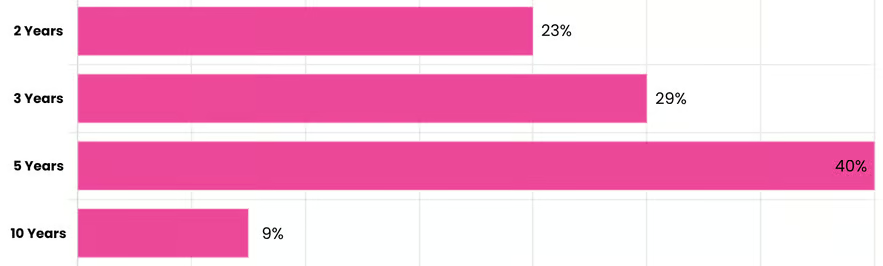
Last Weeks Poll Results:
…and whilst you’re here, can we please take a quick history from you?
Something you’d like to know in our next poll? Let us know!
It’s so easy in life to get drawn into one’s own internal battles. We begin to hold ourselves to such unrealistic standards that we lose the ability to align ourselves with reality. Nowhere is this more the case than when it comes to our finances.
Historically, talking about ‘ghastly’ topics such as money was frowned upon in our profession, as higher virtues such as compassion took their place. Today, however, medics face a new reality: dismiss financial education at your own peril.
The guys at Medics Money have made a name for themselves in the financial scene for doctors, and after examining over 6,000 doctors’ finances, they have given us some key numbers to compare. Remember, this includes doctors of all grades and age ranges, from foundation year doctors to consultants.
41% of doctors admit to impulse buying that has later led to regret, 26% haven’t claimed tax relief, resulting in lost money. 81% save regularly, but 24% lack a three-month emergency fund. 43% of doctors invest in stocks and shares, and 18% invest in rental property. 35% of doctors have income protection, and 49% have life insurance. How do you compare?
Share the News. Build the Community.
Help us build a community for doctors like you. Subscribe & Share On-Call News with a friend or colleague!
*We’ve done our best to keep this information accurate, but person specifications can change. Always check the latest person specification for your training programme before relying on this information.
Disclaimer:
Content in the On Call Newsletter reflects the personal views of individual authors and does not represent the views, policies or guidance of Medset Ltd. Articles are for general information only and do not constitute clinical or professional advice. Medset Ltd accepts no liability for decisions made based on this content.