What a mathematical breakthrough could tell us about the future of medicine
Two years ago, if you asked most professors of mathematics about AI, you’d have got an equivocal shrug. Terence Tao, probably the world’s best-known living mathematician, likened working with one model to advising “a mediocre, but not completely incompetent” graduate student. Then they went back to doing whatever it is mathematicians do.
A week may be a long time in politics, but in mathematics two years has been enough to turn the whole field upside down. For those of you who haven’t been following OpenAI’s recent run in mathematics, here’s the short version:
What actually happened
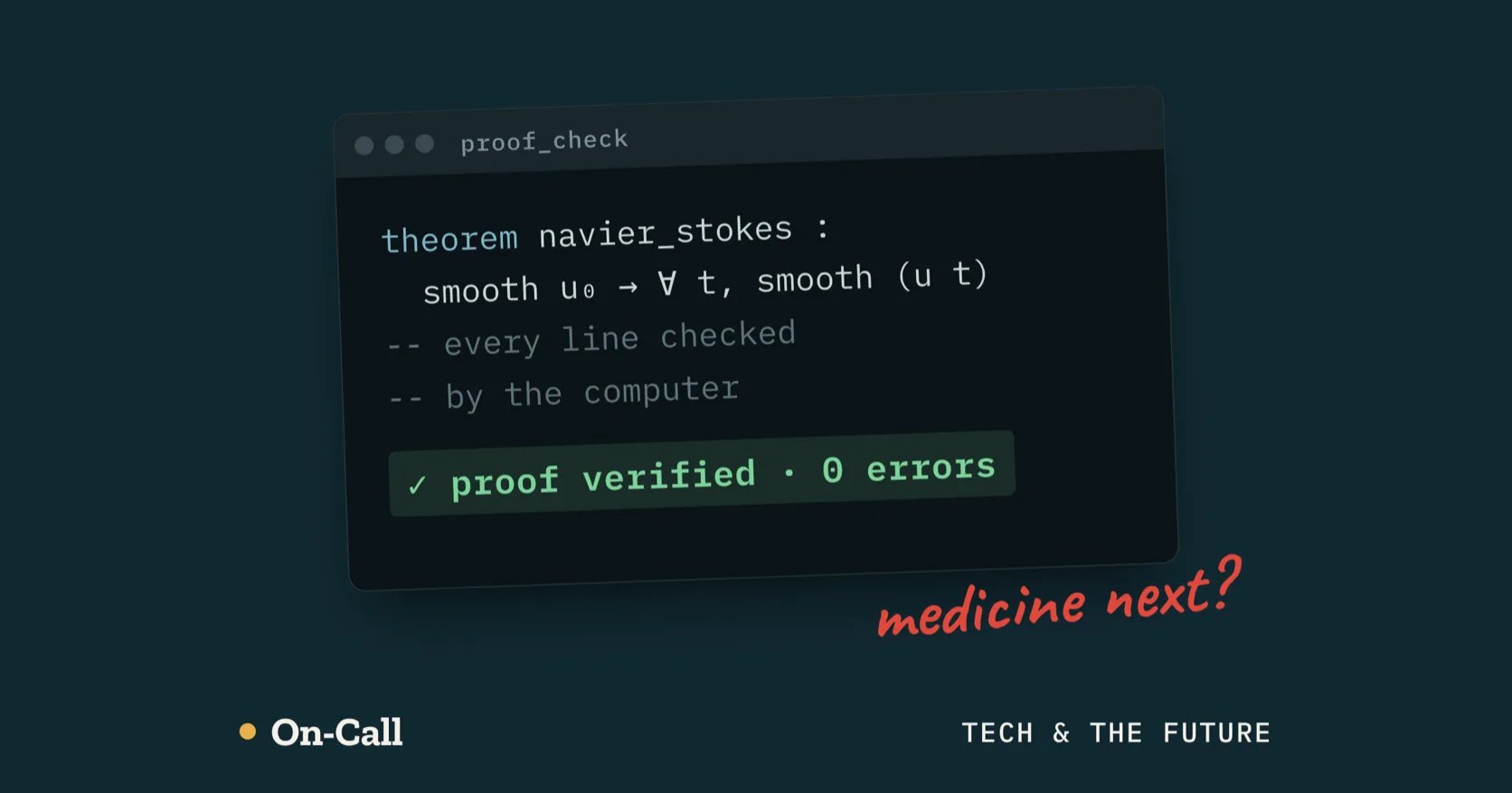
It starts with the Navier–Stokes equations, which describe how liquids and gases move. They help engineers design aeroplanes and meteorologists forecast the weather. Mathematicians, though, want more than equations that work. They want proof, with logical certainty, of how those equations behave. Nobody had managed it, which is why it is one of the seven Millennium Prize Problems. If you solve it, the Clay Mathematics Institute hands you a million dollars.
So when OpenAI announced on the 8th of September that it had found a solution, and had the proof checked line by line by a computer, the maths world paid attention. Charles Fefferman, who wrote the official description of the problem, said he was “thrilled”. The whole thing took under five days.
A leak, a feud and a letter
Now there was a bit of controversy. Two mathematicians working on a related problem with AI help say word of their progress leaked to OpenAI and forced them to rush out their own papers. OpenAI admits it was spurred on by rumours of their work, but says its proof is its own. It has also said it won’t claim the prize.
But this isn’t a one-off. In May, an OpenAI model disproved a decades-old conjecture of Paul Erdős, with the proof checked by outside mathematicians. In August, another set out new results on ten long-open problems, each with a proof a computer can verify.
Days after the Navier–Stokes announcement, 25 Fields Medal winners (think the Nobel Prize of maths, awarded to mathematicians under 40) signed an open letter describing the corporate race to solve as many mathematics problems as possible using artificial intelligence as something that threatens human conceptual understanding and the culture of mathematics.
In two years, the field’s biggest names have gone from grading AI as a bang average graduate student to declaring a crisis. The rate of change is astonishing.
Is medicine next?
Make no mistake: when the leaders of a profession like mathematics start signing open letters, medics can’t afford to walk around with their eyes closed. Most of the talk about AI in medicine concerns the diagnostic specialties like pathology and radiology, and we can see why, but doctors know how algorithmic other parts of medicine can be.
Barriers remain, of course: getting hold of good datasets, regulation, and the small matter of who is legally responsible when the algorithm gets it wrong. Maths also differs from medicine in a fundamental way. A proof can be checked by a computer; a diagnosis is only checked when the patient gets better, or doesn’t. That will slow things down. But it isn’t a reason to dismiss what is happening.
What it means for radiology
Take radiology. As we wrote a fortnight ago, predictions of its demise have a poor track record, but the specialty will still change. Interventional work and the Seldinger technique aren’t going anywhere. Ultrasound looks fairly protected for now, thanks to the hands-on element and smaller datasets, which bodes well for subspecialties like paediatric and MSK radiology.
Plain film reporting looks the most exposed, and with it, the reporting radiographers who do much of that work. Radiologists will be pushed to write genuinely useful reports that tie the imaging to the clinical picture, to show their worth to the department.
A revolution is coming, not just across every specialty in medicine but across most professions. We’ve been told this is our industrial revolution, and with every passing month, and every example like this one, that claim gets harder to dismiss.
So fasten your seatbelts. Tell your sceptical friends in medicine, accounting, maths and law that the working world as we know it is about to change.
Weekly Prescription
Have You Heard of the NHS’ ‘Minimum Waiting Time’ Policy?
You’ve heard of maximum waiting times: the NHS targets for how quickly patients should be seen or operated on. But what if parts of the NHS were making patients wait on purpose, even when there is capacity to treat them sooner, to manage budgets and demand?
That is what a BMJ investigation uncovered. And this isn’t a fringe policy: 17 of England’s 36 integrated care boards have introduced minimum waits of 12 to 16 weeks for procedures such as hip and knee replacements and cataract surgery. Shropshire, Telford and Wrekin and West Yorkshire make no secret of it; both have a 16-week minimum wait for all routine procedures.
Sounds harsh? But is it defensible?
Some ICBs told the BMJ that minimum waits help them use their money effectively and treat people fairly across their population. The logic goes something like this: if you race through the endless cataracts and knee replacements in your area, you may find you have burned through half your annual budget a few months into the year.
Not everyone is convinced though. The Royal College of Surgeons said it was “concerned by the scale” of measures that prolong patients’ pain, and the RCGP called the waits “difficult to justify”.
And who is doing the sums here? Take a patient waiting for a hip replacement who is off work and struggling with day-to-day life. Has anyone counted the sick pay, the lost tax, and the GP appointments and painkillers while they wait into the calculations?
Who Answers the Phone When Martha’s Rule Calls?
Martha’s Rule is coming to every A&E. Someone has to pick up.
In 2021, 13-year-old Martha Mills died of sepsis at King’s College Hospital, after a pancreatic injury from falling off her bike. Her parents repeatedly raised concerns that weren’t acted on, and the coroner found she would probably have survived had she been referred to intensive care promptly. Their campaign gave us Martha’s Rule.
How it works
Since 2024, inpatients, their families and staff in England have been able to call for a 24/7 rapid review from a different team, usually critical care outreach, if they’re worried someone is deteriorating. It now covers more than 200 acute hospital sites and had taken 19,177 calls by July this year. In September, NHS England announced it will reach every A&E, waiting rooms included, by March 2028.
Watching the public reaction has been interesting. Online you’ll find parents convinced Martha’s Rule saved their child’s life, and patients who will tell you it saved theirs. Plenty of doctors, meanwhile, tell you that it is being overused. Perhaps. But this is a profession that answers ‘could it be sepsis?’ with yes every time, and throws Tazocin about like it’s going out of fashion. Erring on the side of escalation is hardly a habit we can criticise families for.
The early numbers show both ways. Of the first 4,903 calls, fewer than half were about acute deterioration, but 241 led to potentially life-saving changes in care, including 93 urgent admissions to HDU or ICU.
So who picks up?
Which brings us to logistics: who will be answering this phone in A&E? Medical registrars up and down the country will be sighing with trepidation, but it could just as easily be an acute medicine registrar, a consultant or critical care outreach. NHS England says its seven-trust pilot, which generated 69 calls, ran without extra clinical staff. That was a pilot, not a Friday night in January.
If it is outreach, their opinion will be welcome. But will they feel comfortable coming down to the ED and entering the world of emergency medicine: the sheer range of presentations, patients whose symptoms don’t fit any neat box, and unwell patients who have been waiting hours for a bed? Will they feel comfortable offering a second opinion there?
Before the phone rings
Until the A&E rollout reaches your trust, the answer will vary from hospital to hospital. So find out now: who holds the Martha’s Rule phone where you work, how quickly are they expected to come, and where are the posters telling families how to call?
STAT Note
The Single Most Important Financial Decision You Will Make
“Should I move my holdings from VWRL to VALL to squeeze out a bit more potential growth.”
“Now that I have maxed out my ISA allowance, are mortgage overpayments the way to go, or should I be filling my general investment account?”
“Are government bonds finally a good option now?”
— A panicked, financially invested medic.
These are all questions people are presenting their AI chatbots or financial advisers. What if we told you that all of them, which take up so much headspace, pale in comparison to one life decision:
Who your partner ends up being…
We can hear the huffing and puffing from the romantics already as they slam down Wuthering Heights on their coffee table. How dare we mix something as superficial and cold as ‘money’ with love and romance? At least let us make the case.
How two people approach spending, saving and investing can make or break your long-term finances. It is also what couples fight about most: in a 2023 Starling Bank survey of 4,000 UK adults, money was the top cause of arguments (29%), ahead of in-laws (20%) and children (17%).
And when it goes wrong, it goes wrong expensively. ONS estimates suggest around 42% of marriages in England and Wales end in divorce. Fair Shares, the largest recent UK study of divorce finances, surveyed over 2,400 divorcees: a quarter ended up with nothing or only debts, more than a third didn’t know the value of their own pension, and only one in ten with a pension yet to be drawn agreed to share it. For doctors, whose NHS pension is often one of the biggest assets they own, that last figure matters.
Values matter in any relationship, and financial values are no different. So instead of obsessing over every other corner of your finances, have the conversation. Talk to your partner about money, understand each other’s values, and see whether your habits are compatible or whether a fracture is waiting to happen.