NHS League Tables: Are We Incentivising the Wrong Goals?
Can Ranking Hospitals Really Achieve What We Want it to?
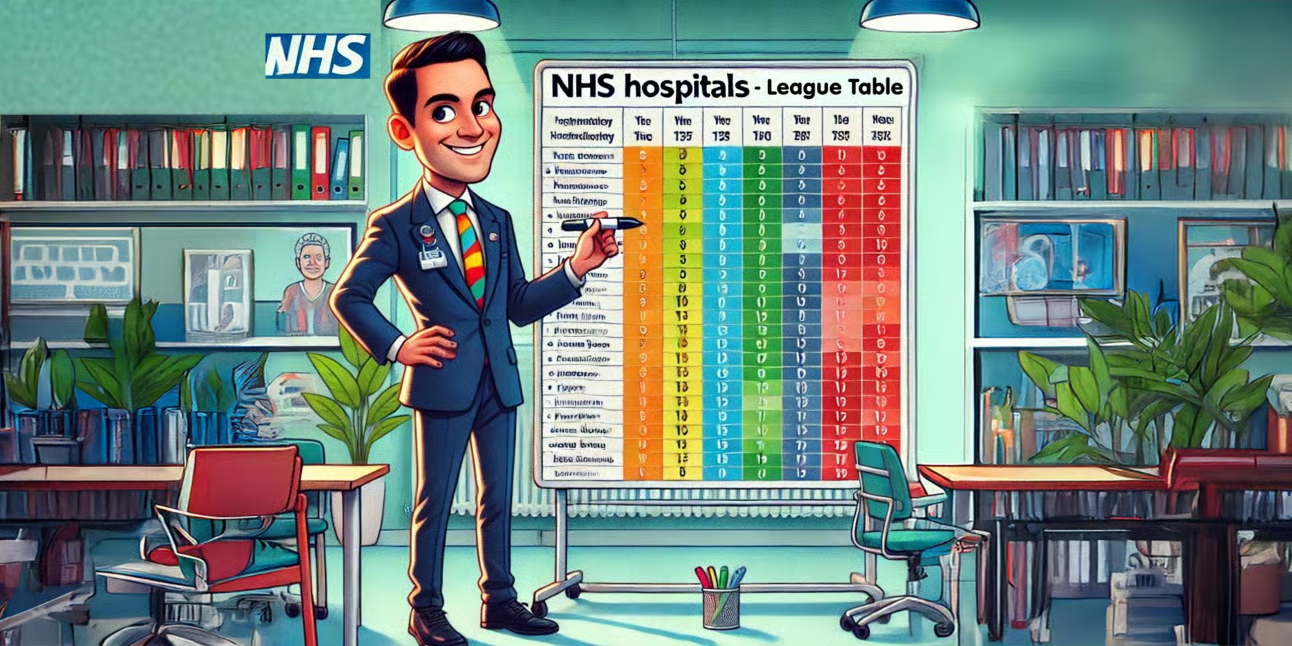
Back to good old Wes Streeting, who made headlines this week with plans to introduce NHS league tables to guarantee “no more rewards for failure.” The vision? For the worst-performing hospitals: bring in “turnaround teams,” sack managers, and shake things up. For the best: more autonomy and capital investment.
But here’s our take: designing a ranking system that’s both fair and accurate is about as easy as getting an USS out of hours
How do we account for the many quirks of geography, demographics, and socioeconomic disparities? Hospitals in leafy suburbs with wealthy benefactors (and pristine Lavazza machines in their doctors’ messes) are hardly fighting the same battles as overstretched trusts in rural or deprived areas.
Sure, some hospitals might excel in patient satisfaction but lag in other areas like innovation—or thrive in urban areas while rural hospitals grapple with older populations and fewer resources. Will these nuances be reflected in the rankings? Doubtful. What we’ll likely end up with is just another tool for the government to shuffle blame downwards.
Using metrics on rankings such as process measures and waiting times might sound good on paper, but do they encourage the right behaviours? Will hospitals rush discharges to hit targets, compromising safety in the process? And can metrics like these truly capture why a hospital might be struggling?
In the world of business (and just about anywhere people love numbers), there’s a principle courtesy of British economist Charles Goodhart. Goodhart’s law goes like this: “The moment you turn a measure into a target, it stops being a good measure.” Or in simpler terms: if you chase the number, the number stops meaning what you think it means. In fact most of us have probably seen managers fiddle with pathways or reset clocks with the goal of tweaking targets.
The rankings could trigger a domino effect: lower-rated hospitals might haemorrhage staff as top employees flee to greener pastures, and recruitment will dry up for those deemed the “worst.” What’s left? Demoralised staff in failing hospitals, caring for increasingly underserved populations.
Call us cynical, but this just feels like a golden goose for “management consultants” with six-figure price tags to swoop in, write obvious reports about problems with a lack of funding and vanish into the ether. The result? Another round of bureaucratic busywork that solves nothing while draining precious resources—however, we’d love to be wrong on this one.
Weekly Prescription
The NHS App: A Digital Revolution or a Digital Divide?
Well, here’s a plot twist for the NHS: the government is unveiling plans to upgrade the NHS App, enabling more patients to book their own appointments and treatments. Sounds like progress, right? But here’s the twist—it’s not just about making things easier for patients. Oh no, this time we’re adding private providers into the mix, so now patients can choose from a variety of treatment options—assuming they can get through the tech hurdles first.
The British Medical Association (BMA), however, has raised a red flag. They’re concerned that this digital upgrade could leave behind patients who aren’t able to access the technology. You know, the ones who still use a landline.
This plan, by the way, is part of the government’s grand vision to hit one of its key election promises: having more than 90% of patients either treated or signed off within 18 weeks of referral by the end of this parliament.
Diaries Of A Neurology Doc
MRI struggles and Neuro battles— as shared by our anonymous resident doctor
I arrive at work, and surprise, surprise—we’re short-staffed again. Standard.
I crack on preparing the list. Today’s lineup? Five more triages from AMU, all 81-year-olds with pneumonia or UTIs. Naturally, they’re being sent to us because Geriatrics at [name of hospital redacted for self-preservation] only takes patients aged 82 and up (yes, that’s an actual rule). Meanwhile, Acute Medicine has decided they can only admit drug overdoses under themselves because of “pressures” Don’t believe me? I’ve got the email receipts.
With no senior input available, it’s just me and another junior equally unqualified to lead a ward round. We divvy up the patients, make no changes to any plans, and accept that nobody is going home—unless it’s Thursday, the magical day when the consultant descends from on high to grace us with their wisdom.
Back to the ward, I go to tackle my jobs. Every patient gets an MRI head to “rule out a structural cause of [insert generic neuro problem here].” If it’s a woman under 40, we throw in magnetic resonance venography too—because you never know, there could be a cavernous venous sinus thrombus lurking in there.
Next, the great radiology battle begins. They insist I call the neurosurgeons at the neighbouring hospital first before ordering the imaging. The neurosurgeons, predictably, tell me to take a hike until we have imaging, because “we can’t comment on a patient we haven’t seen.” Classic.
My afternoon? Dedicated to updating relatives. These conversations typically go like this: “We haven’t found a cause, but we’ve ruled out anything reversible and trialled steroids. This is likely your loved one’s new baseline.”
Then it’s time for the CPR discussions. Inevitably, I end up debating with families who want their 120-year-old granny with stage 5 CKD and less physiological reserve than a piece of gum to be “for full escalation.”
Next, the paperwork marathon: twelve death certificates to complete. With no ash cash in the mix anymore, this has become the ultimate soul-sapping, unpaid admin task.
I update the list again. Nothing has changed and nobody has gone home.
Finally, I trudge back to my car, sit there for ten minutes while it defrosts, and ponder my life choices.
Board Round
A round-up of what’s on doctors’ minds
“Observation is an investigation. Time is an excellent diagnostician.”
“It’s funny when the decision changes when the speciality is asked to see the patient in person in a lot of instances”
“It is almost never worth staying late. Doing non-urgent things out of hours won’t result in better care because people who action non-urgent things (e.g. secretaries or discharge planners) don’t work out of hours”
“Personally I want to know the outcomes of my local trust and how they compare to others in the UK and around the world, and if they don’t compare well then I want to know what the plan is to improve it.”
“Hospital data is useful to analysts, not the general population. A hospital in a deprived town where half the population may drink, smoke or use recreational drugs excessively is going to have a higher mortality rate than some rural affluent areas. That doesn’t mean the hospital staff or management are worse”
Referrals
Some things to review when you’re off the ward…
New guidance on physician associates (BBC News)
Weekly Poll
Have you encountered patients who believe false health information that they have seen on social media?
…and whilst you’re here, can we please take a quick history from you?
STAT Note
Future doctors, brace yourselves—what’s on the horizon for us in the battle against the vaping epidemic? Well, it seems we’re about to inherit a generation with fried dopamine pathways and an addiction to watermelon-flavoured gumball clouds.
A single vape pod can contain up to 60mg of nicotine, whereas a regular cigarette only delivers 1-2mg. So, it’s no surprise that people—especially younger folks—are chain-vaping through pods. Vaping is so convenient: indoors, outdoors, on the bus or in the park. The ease of it all makes it a whole lot harder to get people off this habit, even if they weren’t smokers to begin with.
These vape pods have pulled in kids who would have never touched a cigarette. We’re kidding ourselves if we still talk about quitting smoking as the end goal. Vaping isn’t just a smoking cessation tool; it’s the gateway to a new nicotine addiction.
Vaping is a huge problem, and that’s without considering the long-term health impacts that we don’t even fully understand yet. Good luck, future physicians.
Share the News. Build the Community.
Help us build a community for doctors like you. Subscribe & Share On-Call News with a friend or colleague!
*We’ve done our best to keep this information accurate, but person specifications can change. Always check the latest person specification for your training programme before relying on this information.
Disclaimer:
Content in the On Call Newsletter reflects the personal views of individual authors and does not represent the views, policies or guidance of Medset Ltd. Articles are for general information only and do not constitute clinical or professional advice. Medset Ltd accepts no liability for decisions made based on this content.