Payday Bonus: Backpay Hits Doctors’ Payslips
Multiple Trusts, Multiple Payments: Don’t Lose Out On What You’re Owed…
This month, a wave of excitement (and a fair share of confusion) has swept through the doctor community with the arrival of the long-awaited backpay.
Here’s the deal: your backpay is calculated as 4% of your gross (pre-deduction) earnings for the entire backdated period – before the taxman, student loan company, and pension scheme take their share, of course. For every £100 you earned during that period, you’ll see an extra £4 on your payslip. The 4% applies to your base salary, so it doesn’t include those out-of-hours shifts or on-call work.
Each trust you’ve worked for during the backdated period is responsible for their share of the backpay. Worked at three trusts? Expect the headache of separate payments from all three.
If your backpay feels…off, here’s what you need to know to ensure every penny owed to you finds its way home:
- Ask for a Breakdown
Request a clear breakdown of your backpay calculations from your trust’s payroll team. Make sure it includes your grade, start and end dates, and details for each rotation during the backdated period.
- Involve Your Local BMA Reps
If something doesn’t add up (or feels suspiciously light), don’t hesitate to raise it with your local BMA representatives. They’re there to help untangle payroll mysteries and advocate on your behalf.
- Spread the Word
Let your colleagues know about their entitlement. Backpay isn’t a “finders-keepers” situation—every eligible doctor is owed their share. A little nudge in the group chat might save someone from missing out. This especially applies to members of our international community who may not be too familiar with proceedings.
Weekly Prescription
The Heart of Medicine: Never Losing the ‘Why’
The On-Call team couldn’t help but appreciate ICU consultant Dr. Matt Morgan’s brilliant reminder: as doctors, we must never forget to “hold onto the why.”
Sure, we’re all pros at the what—MRI for bed 4, steroids for bed 10—but how often do we pause to ask why instead of relying on “because the guidelines say so”? Algorithms and flowcharts are great tools, but they’re just that—tools. They don’t replace the value of truly understanding the reasoning behind a decision.
Knowing why transforms a guideline from a handy checklist into a nuanced framework. It connects us to the bigger picture of a patient’s story, equips us to handle unique or tricky situations, sparks research ideas, and helps us care for those conditions that exist outside the neat boxes of clinical recommendations.
So, next time you reach for a guideline, remember—it’s not just about what to do, but why it’s done.
Waste Not, Want Not: Cutting NHS Waste Through Price Tags
How knowing the price of things could save the NHS millions…
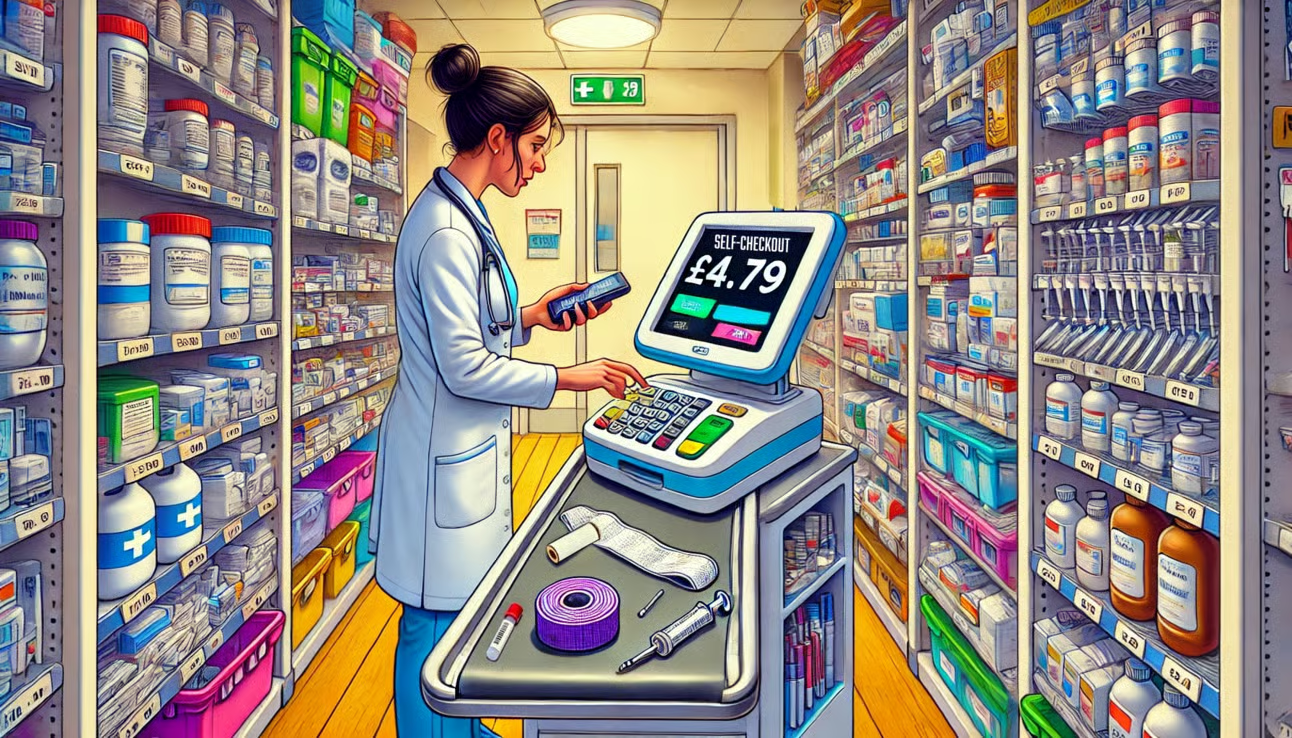
Picture it: you walk into the store room for a venflon. Beneath each item, there’s a price tag—like shopping at a clinical IKEA. You grab the tourniquet, £0.87 flashes in your mind. The gauze? That’s another £0.23. The cannula? Oh, that’ll be £2.10, thank you. Suddenly, you’re calculating the total whilst playing “Who Wants to Save the NHS Millions?”
The NHS’s waste problem is no laughing matter. Take Mid-Yorkshire Teaching NHS Trust, where a staggering 330,000 single-use tourniquets are used each year. By switching to reusable versions, this could shrink to 10,000. Similarly, Northampton General Hospital’s ophthalmology department saved £12,000 by reducing single-use scissors. Last month, the Department of Health and Social Care announced a 2024 initiative to tackle NHS waste. Sure, pumping money into healthcare is crucial, but not without addressing the outgoing waste.
Now, let’s be honest. How many of us have over-prepped for a procedure? Taken two or three spare cannulas “just in case,” only to ace it on the first try and end up binning the extras? The thing is, waste isn’t just about stuff. It’s about mindset. If we all knew the price of what we used, would we think twice before grabbing extra? Supermarkets love telling us how much we’ve saved on our shop. What if the NHS did the same? Imagine discharge summaries with a breakdown of costs—“Your inpatient care totalled £4,300; hope you enjoyed your tea and toast!”
Humans have a funny relationship with value. A 50p newspaper is more likely to be read than a free one because price assigns worth. The same applies to healthcare. If patients saw the cost of their hospital stay, would it foster more appreciation? And if clinicians knew the price of every item we touched, would we waste less?
What we need isn’t guilt—it’s awareness. Let’s attach value to the valueless.
Board Round
A round-up of what’s on doctors’ minds
“I present to you the Sepsis Paradox: CRP 250? Sepsis. Start Taz.
CRP 5? Must be lagging. Sepsis. Start Taz.”
“Someone once said that it’s impossible to see an unhappy anaesthetist – try sending for the last case at 4:50 then get back to me”
“What would your medical-related band name be? Anna and the Phylaxis, Toxic Megacolon (death metal), Flu fighters, aortic monkeys or Dr DRE”
Referrals
Some things to review when you’re off the ward…
Weekly Poll
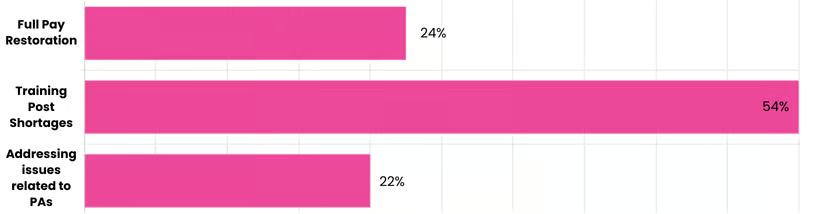
What do you think should be the current priority for the BMA?
…and whilst you’re here, can we please take a quick history from you?
STAT Note
Many in our On-Call community have done the financially mature thing—building an emergency fund with 3–6 months of expenses. But unfortunately, that money is often sitting in high street banks. The reality is that banks like Barclays, Halifax, NatWest, and HSBC are taking the mickey with their low interest rates, and the FCA has had to step in to encourage fairer treatment for customers.
Right now, you can get over 5% variable interest in easy-access cash ISAs like Moneybox or Trading 212. These options beat inflation, offering better returns than the high street banks, but many stick with the familiar names out of trust. Don’t forget, these alternative accounts are also FCA-regulated and FSCS-protected up to £85,000.
So, if your emergency fund is sitting in a sub-par savings account, it might be time to rethink where it’s parked. Don’t let your hard-earned money sit idle.
Share the News. Build the Community.
Help us build a community for doctors like you. Subscribe & Share On-Call News with a friend or colleague!
*We’ve done our best to keep this information accurate, but person specifications can change. Always check the latest person specification for your training programme before relying on this information.
Disclaimer:
Content in the On Call Newsletter reflects the personal views of individual authors and does not represent the views, policies or guidance of Medset Ltd. Articles are for general information only and do not constitute clinical or professional advice. Medset Ltd accepts no liability for decisions made based on this content.