

Introduction
This UK medicine application guide takes you from the first question, is medicine right for me, to your first day at medical school: the routes in, entry requirements, UCAS, the UCAT, the personal statement, work experience and interviews. Dates and figures are for 2027 entry (applications made in autumn 2026). For a later year the process is the same, but check the dates with UCAS and UCAT, because they move every year.
Before applying to medicine, you should do all you can to ensure that this is the right career for you. This can be a difficult decision for many, as even those in the late stages of medical school or in their first years of work are only just finding out what life as a doctor is really like.
Before deciding to apply, speak to medical students or junior doctors, find some work experience and attend open days whenever possible. Ask yourself what your motivations for becoming a doctor are. Is it the reward of helping others? Is it the esteem? Is it the financial reward? (Although this certainly isn’t as much as many other professions).
The most important step in making this decision is taking the time to reflect and think about what it is you want from life and the values that are important to you.
This career is not for everyone. It may be you realise that your life ambitions and values don’t line up with a career in medicine, and there is absolutely no shame in that. There are equally amazing careers that you can pursue successfully that are completely unrelated to medicine.
But if, after some honest reflection, you still believe that this is the career for you, then read our guide, use our resources and prepare yourself for the exciting road ahead.
| The Good | The Not So Good |
|---|---|
| Career centred on helping others | A stressful career at times |
| Hugely respected profession | Years of training |
| A secure job for life | Lots of exams even after medical school |
| Intellectually challenging | Unsociable hours (weekends, nights, bank holidays) |
| Rich opportunities for the future |
Routes To Medicine
Undergraduate (Standard Entry)
An undergraduate is someone who doesn’t have any previous degrees and is studying at university for the first time. The vast majority of medical students are undergraduates who entered university after sixth form or college.
Standard entry medicine usually takes five years, although some universities offer a six-year version. The degree is often abbreviated to MBBS or MBChB, but they all lead to the same bachelor’s degree in medicine. Full-time tuition fees in England are capped at £9,790 a year in 2026/27, and from year 5 the NHS Bursary pays tuition fees for eligible students.
Postgraduate (Graduate Entry)
Some students embark on a medical career having already completed a university degree. Graduates can apply for a standard five-year course or for a graduate entry medicine (GEM) course, which is usually four years. Most schools ask for at least a 2:1, although some accept a 2:2, and some GEM courses are open to UK students only.
On a GEM course the NHS Bursary contributes up to £3,930 a year towards tuition fees in years 2 to 4, and you are responsible for the rest. Funding rules for graduates differ from those for school leavers, so check your position with Student Finance England and the university. Graduate entry courses use either the UCAT or the GAMSAT, covered under Admissions Tests below.
Foundation Courses (Preliminary or Gateway Year)
If you don’t meet the grade requirements for medical school, or you have faced significant barriers to your learning, medicine with a gateway year may be a good option. These courses are usually six years, open to UK students only, and use adjusted entry criteria. The Medical Schools Council says there are now 19 gateway courses, up from four in 2014. Each university sets its own eligibility rules, such as being the first in your family to go to university, living in an area with low higher education participation, or attending a school with below-average GCSE attainment. Use the Medical Schools Council entry requirements tool to compare courses; many gateway courses also ask for the UCAT.
Medical Degree Apprenticeships
NHS England funded two pilot cohorts of medical doctor degree apprenticeships, in 2024 and 2025, and has decided not to fund new recruits beyond the 2025 cohort. Plan your application around the routes above.
What Do Doctors Do?
A doctor is someone who is medically trained to diagnose, treat and care for patients. To become a doctor, you need to complete a university medical degree and register with the General Medical Council (GMC) in order to practise. UK graduates must also pass the GMC’s Medical Licensing Assessment as part of their degree.
There are around 60 different specialities within medicine, ranging from general practice to paediatrics, and surgery to histopathology. Each speciality is unique and has different training pathways. The end goal for most doctors is to become either a fully qualified GP or a consultant in their area of interest.
During training years you’ll be referred to as a junior doctor, which covers everyone from foundation year doctors up to senior specialty trainees. After graduating you complete two years of foundation training, then three years of GP training or five to eight years in another speciality. NHS Health Careers puts the total at a minimum of nine to twelve years from starting medical school to becoming a consultant.
Career Pathway

Example Career Pathways
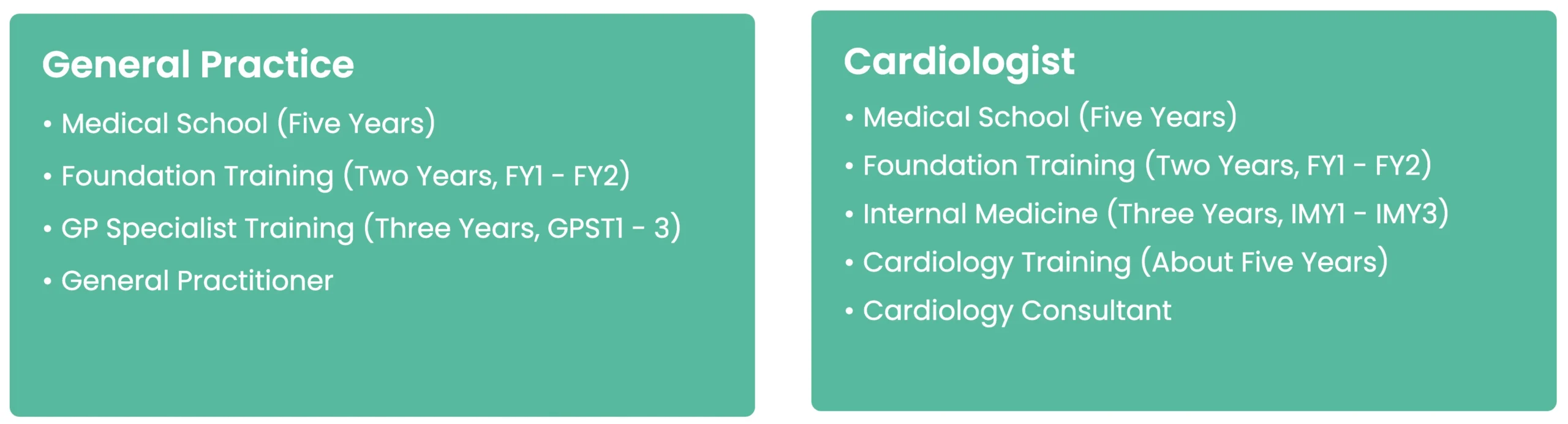
A GP goes straight from foundation into three years of GP training. A cardiologist completes three years of Internal Medicine Training, then around five years of cardiology training.
UK Medical Training
Foundation Training
Every new doctor must go through foundation training after leaving medical school. The UK Foundation Programme is a two-year, paid programme (FY1 and FY2). During this period you’ll learn the basics and build ‘foundations’ as a junior doctor, and get a flavour for specialities that you might wish to pursue. You apply through Oriel in the autumn of your final year.
Under the Medical Training (Prioritisation) Act 2026, graduates of UK and Irish medical schools (plus Iceland, Liechtenstein, Norway and Switzerland) are offered foundation places before other applicants, and specialty training is prioritised in a similar way. What counts is where you qualify, not your nationality.
Core Training
You’ll most likely undertake some ‘core’ training in your area of interest, giving you a basis for more advanced specialist training. Core training is two years (for example, core surgical training) or three years (for example, emergency medicine and psychiatry). Those interested in medical specialities do Internal Medicine Training, a three-year programme that replaced Core Medical Training in 2019 and is completed with the MRCP(UK) diploma.
Speciality Training
To apply for higher specialty training, doctors go through a competitive recruitment process. The length varies by speciality, and when you move into higher training your grade changes from CT to ST. A doctor who has completed two years of core surgical training, for example, becomes an ST3 in general surgery.
Some specialities, such as general practice, paediatrics and ophthalmology, are known as run-through. You apply once and, subject to satisfactory progress, continue for the full programme, which lasts five to eight years. In others, such as anaesthetics and Internal Medicine Training, you apply at core level and must be successful again to enter higher specialty training.
Consultant
After completing specialist training you’ll acquire a Certificate of Completion of Training (CCT) and be eligible to apply for a consultant job. That takes at least nine to twelve years from starting medical school.
GP Training
General practice training lasts three years after foundation, so you can become a fully qualified GP five years after graduating.
Applying To Medicine
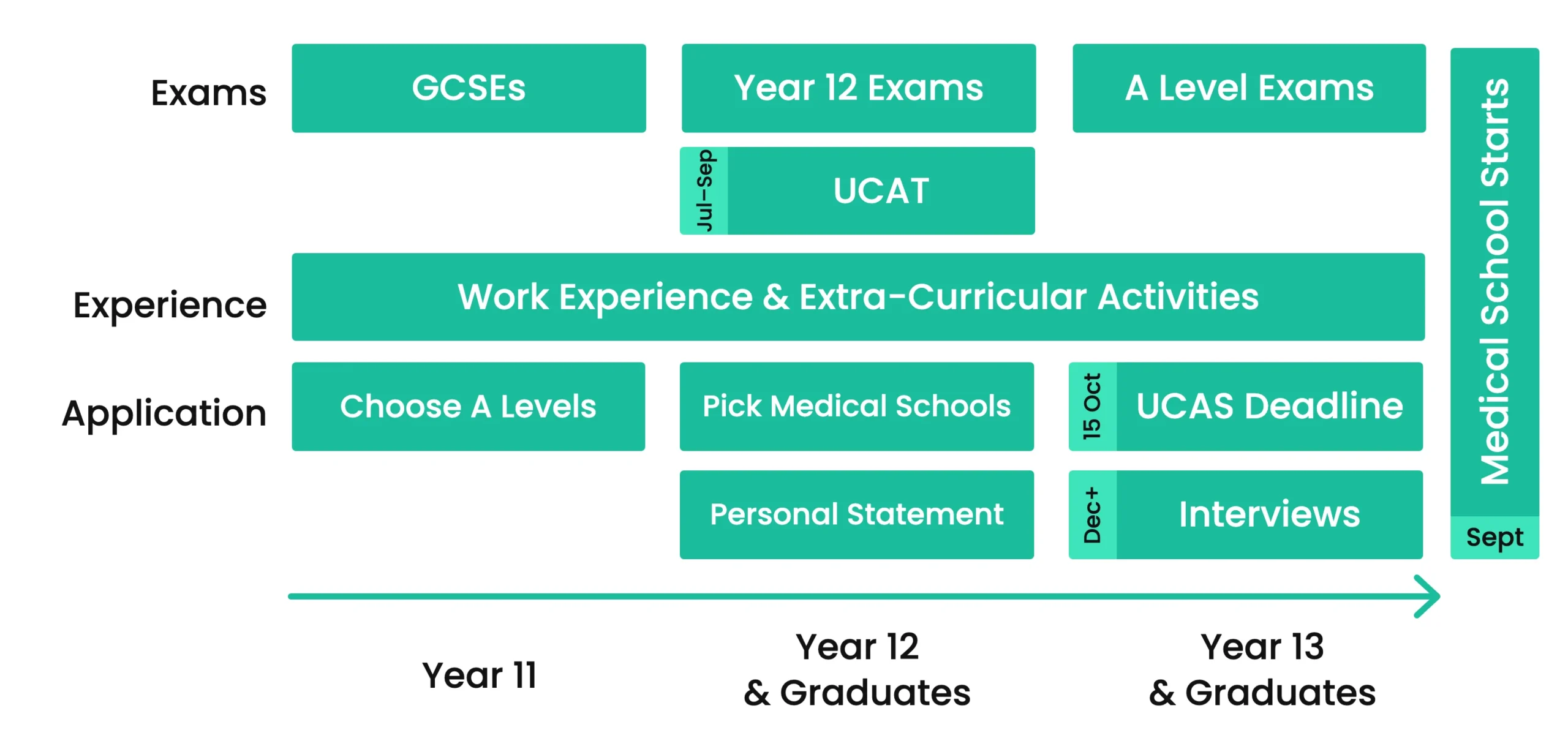
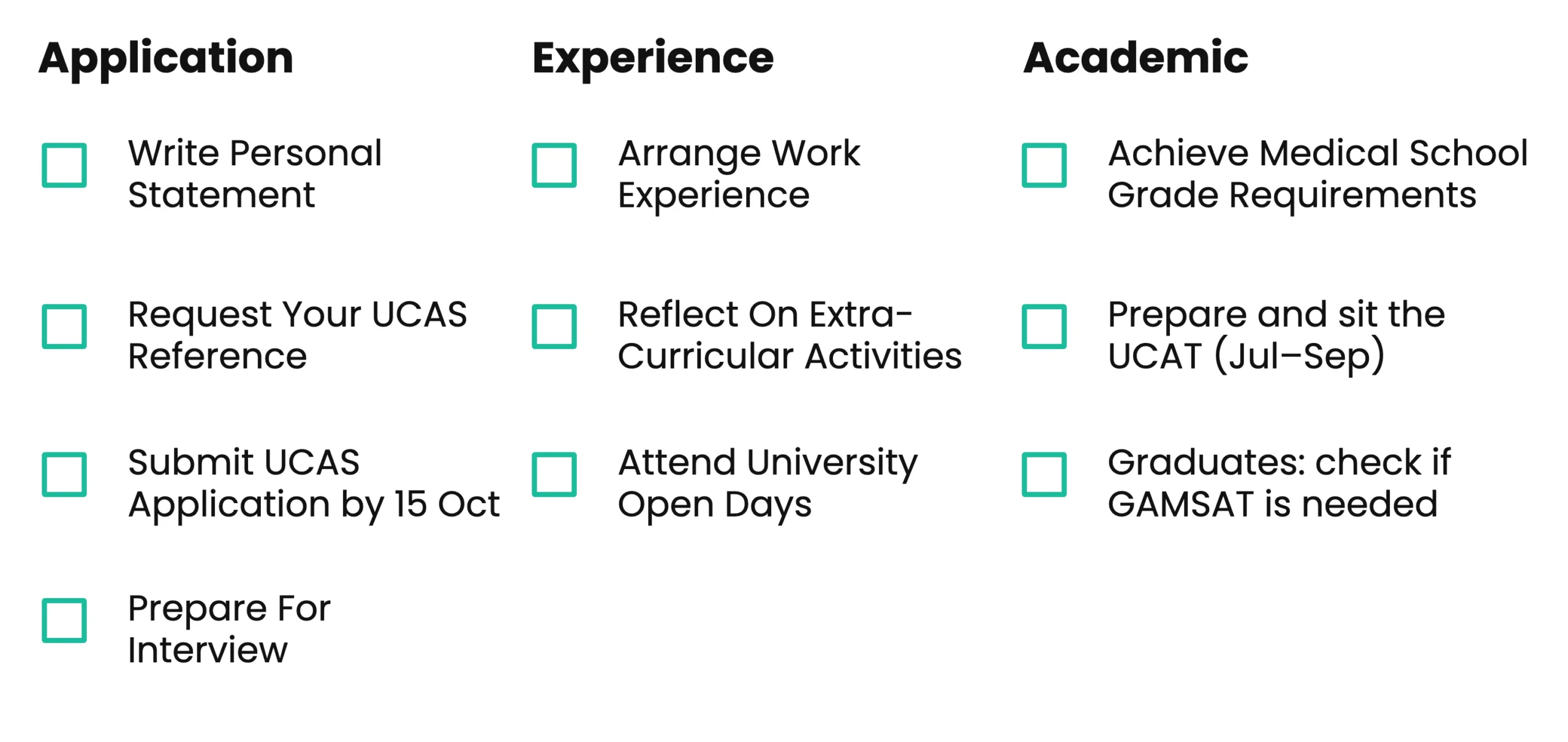
Preparation starts well before the application itself. The timeline below shows how the stages line up; graduates follow the same cycle.
Key Dates For 2027 Entry
| When | What happens |
|---|---|
| 12 May 2026 | UCAS applications open: you can register and start your application |
| 20 May 2026 | UCAT registration opens (bursary and access arrangement applications also open) |
| 23 June 2026 | UCAT booking opens |
| 13 July to 24 September 2026 | UCAT testing window (registration and booking close on 16 September, 15:00 UK time) |
| 1 September 2026 | Earliest date you can submit your UCAS application |
| 15 October 2026, 18:00 UK time | UCAS deadline for medicine, dentistry, veterinary courses, and Oxford and Cambridge |
| Early November 2026 | UCAT results delivered to universities |
| December 2026 onwards | Interviews: Oxford interviews in December, Leeds on 4 to 6 January 2027 |
| 13 January 2027, 18:00 UK time | UCAS equal consideration date for most other courses (relevant to your fifth choice) |
| September or October 2027 | Courses start |
The deadline is 15 October every year. For later years, check the new dates on UCAS and UCAT.
UCAS Application
The Universities and Colleges Admissions Service (UCAS) runs the course application process for all UK universities. No matter your route to medicine, undergraduate or graduate, you apply through UCAS.
Grades You Will Need
Entry requirements vary by university, so check each course page. For 2027 entry, Oxford asks for A*AA with chemistry, Cambridge’s minimum offer is A*A*A, and Leeds’ standard route asks for AAA including chemistry and biology. GCSE requirements apply as well. Compare courses with the Medical Schools Council tool.
How Competitive Is Medicine?
Very. UCAS reported 25,770 applicants for medicine at the 15 October 2025 deadline (for 2026 entry), up 10.4% on the 23,350 the year before. The UK-wide intake in 2025-26 was 11,266 students, according to the Office for Students. The two numbers are not a simple ratio (applicants choose up to four schools, and the intake includes international and graduate students), but they show why preparation matters.
Choices, Fees And Deadlines
- You can apply to a maximum of four medicine courses. You have five choices in total, so your fifth can be a different subject. This is often a good ‘plan B’ in case you don’t get accepted.
- For 2027 entry, applications opened on 12 May 2026 and you could submit from 1 September 2026.
- The deadline for medicine is 15 October at 18:00 (UK time). UCAS guarantees equal consideration only for applications that arrive by then, and the Medical Schools Council says later medicine applications will not be accepted, so treat it as fixed.
- The application fee for 2027 entry is £34.50 for up to five choices.
- You need a reference from someone who isn’t a family member, friend, partner or ex-partner, so ask early.
If you’ve got your heart set on medicine, we’d advise choosing a science-based degree so that later ‘graduate entry’ will be easier if required. You may decide to choose something completely different like fashion or music, but bear in mind that applying to medicine as a graduate with a non-science degree can make things much more tricky.
UK Medical School Guide
How To Choose The Right Medical School
The Medical Schools Council’s directory lists around 50 UK medical schools, and picking the right one can seem stressful. You’ll be studying there for four to six years, so examine the following factors closely…
The Course
Traditional Learning
In the first few pre-clinical years of a traditional course, you’ll find you’re in lectures almost all the time learning anatomy and physiology.
This is much less interactive than PBL-based courses but you are generally given more guidance with your learning.
Typically there is much less patient contact in the first few years of a traditional course until you reach the clinical years (usually year 3 or 4).
Problem Based Learning
The main emphasis of PBL is self-directed learning. You’ll meet a few times a week in small groups with a facilitator and be presented with a medical case from which you’ll tease out learning objectives. This is a very interactive way to learn but requires a lot of self-motivation. There is usually much more early patient contact with PBL-based courses.
Integrated Learning
Many universities now use an integrated style of teaching. In an integrated course, instead of learning all your anatomy and then all your physiology separately, you tackle them holistically by learning them both via body systems.
For example, in your neurology module, you’ll learn your neuroanatomy and physiology together, as well as the common conditions that affect the nervous system and how to perform a neurological examination.
Intercalated Degrees At Medical School
Intercalation is an additional year of study in the middle of medical school where you can obtain another degree such as a BSc or Masters in an area of your interest.
At some medical schools intercalation is built into the course. Oxford’s medicine course, for example, is six years and includes a compulsory intercalated degree in year 3. Elsewhere it is optional, and it is a big financial commitment to add an additional year of study. Obtaining an additional intercalated degree can make your application for future specialist training after medical school more competitive.
Academic Requirements For Medical School
The first thing to consider is your academic results: the GCSE and A level or Higher grades and subjects your medical school stipulates. Most schools also require an admissions test, usually the UCAT, with the GAMSAT used by a few graduate entry courses. You can find both on each school’s website and in the Medical Schools Council entry requirements tool.
Best Medical Schools By University Ranking
League tables, such as The Guardian’s, rank UK medical schools on factors from student-to-staff ratio and academic spend to student satisfaction. Treat them as one input rather than the answer.
Location & Living Costs
Location is an important factor for many. Some people like urban cities whereas others are suited to smaller towns that aren’t too far from home.
Different universities have vastly different student accommodation costs and city living is often much more expensive (especially in London), so this needs to be factored into any budgeting.
Campus Life
The best way to get a feel for the medical school is by visiting open days and asking what other students like and dislike about their uni. Campuses vary in their sports facilities and the size of their students’ union events. A good place to start is by looking at the university students’ union website.
Admissions Tests
University Clinical Aptitude Test (UCAT) Guide
The University Clinical Aptitude Test (formerly UKCAT) is the admissions test used by most UK medical schools. It is delivered at Pearson VUE test centres, and the UCAT Consortium list shows which courses require it for 2027 entry.
The test has four separately timed, multiple-choice sub-tests and takes just under two hours. It is marked on the number of correct answers, with no negative marking:
| Sub-test | Questions | Time | Score |
|---|---|---|---|
| Verbal Reasoning | 44 | 22 min | 300 to 900 |
| Decision Making | 35 | 37 min | 300 to 900 |
| Quantitative Reasoning | 36 | 26 min | 300 to 900 |
| Situational Judgement | 69 | 26 min | Band 1 (highest) to 4 |
The three cognitive sub-tests give a total between 900 and 2700, and the Situational Judgement Test is reported as a band. Abstract Reasoning was removed in 2025 (UCAT said it was more coachable and less predictive), so older resources that mention five sections or a 3600 total are out of date. In 2026, 42,359 tests were taken; the mean scaled scores were 602 for Verbal Reasoning, 640 for Decision Making and 675 for Quantitative Reasoning (total mean 1918), and 15% of candidates were in SJT Band 1, 40% in Band 2, 34% in Band 3 and 11% in Band 4.
How Universities Use The UCAT
Cambridge looks at your overall cognitive score, not the situational judgement result, with no minimum score. Leeds uses the overall score alongside your GCSEs, predicted grades and contextual information, with no fixed cut-off. Oxford uses it to decide who is shortlisted for interview.
UCAT Rules And 2026 Dates
You may only sit the test once in any cycle, and your result is valid only for the entry year you registered for (for the 2026 test, 2027 entry or deferred 2028 entry), so you sit it again if you reapply. In 2026, registration opened on 20 May, booking on 23 June, testing ran from 13 July to 24 September, and registration and booking closed on 16 September at 15:00. A bursary covers the test fee for eligible UK candidates.
Make sure any revision resource reflects the current four-section test. You can register your interest in Medset’s UCAT question bank on that page.
BioMedical Admissions Test (BMAT) Guide
The BioMedical Admissions Test (BMAT) no longer exists. Its provider discontinued it after the October 2023 sitting, the last one, used for 2024 entry. Oxford, Cambridge, Imperial, UCL, Brighton and Sussex, Lancaster and Leeds all used to ask for it and now use the UCAT. If you see BMAT in an older guide, you can ignore it.
Graduate Medical School Admissions Test (GAMSAT) Guide
Some graduate entry courses use the GAMSAT instead of the UCAT. It has three sections: Written Communication (two essays), Humanities and Social Sciences, and Biological and Physical Sciences, and it is sat in March and September. For 2027 entry, City St George’s and Ulster University require the GAMSAT, with at least 50 in each section, and ScotGEM at St Andrews requires it instead of the UCAT. Nottingham, which used the GAMSAT for 2026 entry, has switched to the UCAT for 2027. Schools change their requirements, so always check the course page before you register for either test.
Medicine Personal Statement
What Is A Medicine Personal Statement?
In addition to getting the required grades and a good UCAT score, you’ll need to write a personal statement. UCAS allows up to 4,000 characters, including spaces. It should show your motivation for a career in medicine and why you should be chosen over the thousands of other students applying.
It’s never too early to start, and the sooner you draft one, the more you can refine it. Medical schools use it differently: many treat it as a starting point for interview discussions, others score it, and some may not use it at all. Check how each of your schools uses it before you apply.
How To Write A Medicine Personal Statement
For 2026 entry onwards, UCAS asks you to answer three questions rather than write one block of text, and you can split your 4,000 characters between them however works best:
- Why do you want to study this course or subject? Your motivation for medicine.
- How have your qualifications and studies helped you to prepare for this course or subject? Your academic interests.
- What else have you done to prepare outside of education, and why are these experiences useful? Your work experience, volunteering and extra-curricular activities.
Medical schools look for the values in the Medical Schools Council’s statement on core values and attributes, such as communication, teamwork, respect, resilience, empathy and honesty. Show these through what you have done, rather than listing them.
Medicine Work Experience
What Counts As Work Experience?
Work experience is an important part of the medical school application, although the Medical Schools Council is clear that it is not mandatory and that doctor shadowing is helpful but not essential. It describes two types: caring or service roles, such as volunteering, and observing healthcare, in person or online. Paid and unpaid roles both count, and weekend jobs count as long as you reflect on what you’ve learned. Read its work experience guidance and check each school’s own page.
Start Searching Early
We advise starting your enquiries as soon as possible, ideally a year before your application is due. Although you won’t gain a full understanding of the NHS in a short placement, it will give you an idea of what it’s like to work in a caring profession, and an appreciation of the challenges healthcare workers encounter.
Work experience lets you develop your communication skills with doctors, nurses and patients. Don’t worry if you don’t know about the medical conditions you see (you can read about them later). Take the time to talk to patients about their conditions and how it affects their lives.
It also gives you lots to talk about at interview. Most candidates seek experience in a local GP practice, hospital, hospice or care home, but these days it’s not enough to just complete your placement. To stand out, reflect on each experience and why it’s made you want to pursue a career in medicine.
How Do I Get Medical School Work Experience?
This can be difficult, especially without NHS contacts. Don’t be upset if your request is turned down: it’s usually because the hospital or GP practice has to accommodate students already studying.
Ask friends and family whether they have NHS connections. If your school has a work experience co-ordinator, they usually keep a list of placements previous applicants have been on. GP practices have a ‘practice manager’ you can email, and their details are usually on the practice website. For confidentiality reasons, you won’t be able to get experience at a GP practice where you’re a patient.
Contact local hospitals at least 6 to 12 months before your application, as they deal with hundreds of requests, and ask what the placement requires, for example a DBS check, so you can arrange it early.
If you can’t get an in-person placement, the Medical Schools Council points to Brighton and Sussex Medical School’s virtual work experience and the Royal College of General Practitioners’ Observe GP programme. Care homes, community volunteering, medical charities and customer service roles also build the skills medical schools look for. You can register your interest in Medset’s own placements on our Medicine Work Experience page.
Voluntary Work
Not only is it a great thing to donate your time and efforts to a good cause, but you’ll also discover things about yourself and other people that will be invaluable lessons for life. You don’t need to volunteer in a medical setting (such as a care home or hospice) but some medical schools look at this more favourably. A commitment that lasts for months rather than days gives you far more to reflect on at interview.
Hospices
Hospices will let you experience care for people who are usually at the end of their lives. It can be an emotional place to work but it will give you the chance to see good holistic patient care. Contact local hospices early.
International Placements
You can use travel companies to arrange healthcare work experience abroad. It is not essential and can be expensive and time-consuming, but it will give you experience of another country’s healthcare system and plenty to talk about at interview.
Making The Most Of Work Experience
Research the department or practice you’re going to be placed in, and read up on the common conditions it sees. Ask questions, ask to get involved and show that you’re genuinely interested. You’ll take far more from the placement with a positive attitude.
Record what you’ve seen and the patients you’ve spoken to (without writing down any identifiable information) so you can reflect on it over the coming weeks, and jot down anything unclear to read about later or discuss with one of the doctors.
In addition to this, use the Medical Schools Council’s work experience reflective diary, produced with the Royal College of General Practitioners, to document the personal attributes you have developed on each placement. It is useful for your personal statement and at interview.
Medical School Interviews
How Do The Interviews Work?
So your application has been successful and you’ve been invited to interview. This is when the real preparation must begin. Most students find it the most stressful part of the process, being asked questions by senior doctors, health workers and laypeople. The Medical Schools Council describes four formats, and your university will tell you which to expect: traditional panel interviews, multiple mini interviews (MMIs), assessment centres and online interviews, including some where you record your answers on video.
Traditional Panel Interviews
In a panel interview, two or more interviewers, who may be clinical and admissions staff, a senior student or a member of the public, ask you a series of questions, usually over 20 to 30 minutes. Topics range from your personal statement and motivations to science or ethical dilemmas. Oxford, for example, holds online panel interviews in December.
Multiple Mini Interviews (MMI)
Similar to speed-dating, in a multiple mini interview you rotate through a circuit and are given questions and tasks by a new interviewer at each ‘station’. Stations can include discussing your personal statement, breaking bad news to an actor, talking through an ethical dilemma, or teamwork and communication tasks. Leeds uses MMIs, with interviews for 2027 entry on 4 to 6 January 2027, and Cambridge’s graduate course uses an online MMI.
Some schools run a full-day assessment centre, and if your interview is online, choose a quiet room with a neutral background and test your equipment beforehand.
Preparing For Your Interview
Maximise your chance of interview success with our Medicine MMI Interview Course, which covers MMI and panel questions, and practise in realistic conditions with our MMI Mock Interview Circuit (register your interest on that page). Our Get Into Medicine Conference page lets you leave your email to hear when the next date is confirmed.
What If I’m Rejected?
Don’t Be Disheartened
Getting into medical school is tough, and not everyone is successful first time. Many fantastic doctors working in the NHS right now weren’t successful until their second or third go and it hasn’t hindered their careers going forward.
Just because you’ve been rejected does not mean that you couldn’t be a fantastic doctor too. It may be down to things outside of your control, such as a bad day at interview, or missing a grade.
If you do miss the grade to meet your offer requirements, call up the medical school and explain the situation (they may still give you the place if you’re borderline), or if you’re seeking an exam re-mark, explain this so they can hold your place until the result comes back. Similarly, if you’ve got extenuating circumstances such as a recent bereavement or illness, you can explain this to the medical school but you’ll need to provide written evidence.
If despite your hard efforts you still don’t get a place, take this time to reflect and consider your next steps:
Medicine UCAS Extra And Clearing
If you only used four choices because you applied for medicine and were unsuccessful at all of them, UCAS says you can’t normally use Extra, but if you see a medicine vacancy you should contact the university to check whether places are still available. Some medical schools have also been known to offer places through Clearing, so pick up the phone straight away if you think you’re a borderline candidate.
Take A Gap Year & Re-Apply
If you still think this is the career for you, work on the aspects of your application that need strengthening. Your UCAT result is only valid for the entry year you registered for, so you will need to sit the test again. If you have missed the 15 October deadline, the Medical Schools Council says later medicine applications will not be accepted, so use the time to prepare for the next cycle.
Graduate Entry
Although a longer route, you could study a non-medicine degree and apply to medicine again as a postgraduate towards the end of your first degree.
Choose A Different Degree
You may realise that medicine is not for you but another degree is. This minor setback may lead to an equally fruitful career in something completely unrelated to healthcare.
Gap Years
Making The Most Of It
You might decide to defer your entry to medical school by taking a gap year, or you may have been given no choice if your application was unsuccessful. To defer, select a deferred start date on your UCAS application and contact the university before you submit, because it is up to each university whether they accept it. Usually you can only defer by one year, and your offer conditions don’t change. A 2026 UCAT result covers 2027 entry or deferred 2028 entry.
Whatever the reason, a gap year can be one of the most rewarding times of your life. If you decide to take one, consider the following…
Enjoying Yourself
You’re free for 12 months to do whatever you want, pursue a passion, travel the world, have life-changing experiences. Just make sure you make the most of it.
Seeking Employment
Most gap year students wishing to travel will seek work for a few months so they can save up and travel. If possible, try and get one related to something in the medical field such as care work or working in a GP practice (although this isn’t essential).
Volunteering
Not only will this bolster your application for next time, but it’s also a great thing to dedicate your time to. You may wish to incorporate this into any travelling that you’re planning.
Improving Your Application
The most vital part of your gap year preparation if you didn’t get a place is working on the parts of your application that need improving. Get involved with new hobbies or learn new skills. You may wish to look at our comprehensive medicine interview course, which covers common medical school interview questions.
Frequently Asked Questions
When is the UCAS deadline for medicine?
15 October at 18:00 UK time. For 2027 entry it was Thursday 15 October 2026. It also applies to dentistry, veterinary courses, and Oxford and Cambridge.
Do I still need to take the BMAT?
No. The BMAT was discontinued after the October 2023 sitting, and the universities that used it now use the UCAT.
Which admissions test do I need for medicine?
Most UK medical schools ask for the UCAT. A few graduate entry courses use the GAMSAT. Check each course page, because requirements change.
How many medical schools can I apply to?
Up to four. You have five UCAS choices in total, so your fifth can be a different subject.
Do I need work experience to get into medicine?
The Medical Schools Council says it is important but not mandatory. Paid and unpaid roles both count, and what matters most is what you learn and how you reflect on it.
Can I apply to medicine if I already have a degree?
Yes. Graduates can apply for a standard course or a graduate entry course, which usually takes four years and typically asks for at least a 2:1.
Can I defer my place?
Possibly. Each university decides, so contact them before you submit. Usually you can only defer by one year.
About The Author
Sean is a Urological Surgeon and Chief Investigator of a UK cancer research study. Sean is passionate about medical education, technology in healthcare and generating translational research that improves patient and clinical outcomes.