Can We Bring Back the Best of the Firm?
The way to rebuild mentorship and support in training, or just nostalgia…
Before the Foundation Programme, resident doctors didn’t rotate like they were on a merry-go-round. Instead, they worked in the now-discontinued ‘firm’ system—a setup where a “firm” was essentially a team led by a consultant (the permanent fixture), with the most junior resident doctors sticking around for 6 months or more. This model was scrapped in 2005 with the launch of the Modernising Medical Careers programme, and ever since, older doctors have been reminiscing about the good old firm days. But why the nostalgia?
One big complaint about today’s training? Trainees rotate faster than a surgeon scrubs up, making it nearly impossible to form lasting relationships within departments. Some even say this is why physician associates have proliferated—they’re permanent, like the department’s reliable roommate who’s always around, while the resident doctors are the friend who occasionally pops by and leaves dirty mugs in the sink.
Nowadays, it’s not uncommon for trainees to go months without working with the same consultant twice, and a 2023 GMC survey found 55% of them felt they lacked mentorship or support for training and research.
The old firm system, on the other hand, was like a family, albeit a potentially dysfunctional one. Sure, it had its downsides—if you didn’t gel with your team or consultant, it could be tough—but at least you knew who your colleagues were, and you weren’t constantly guessing which consultant you’d be working with next week. The predictability helped build rapport and a support network, something today’s shift-based system seems to have lost.
Bringing back the firm system may not be practical, but we definitely need to revive the mentorship and camaraderie it offered. Because, let’s be honest, medicine’s hard enough without feeling like a medical nomad.
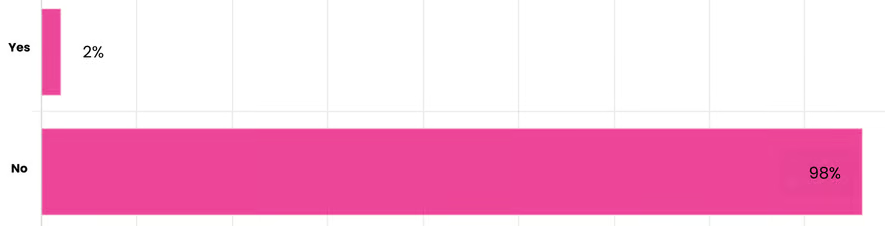
Let us know if you agree or not in this week’s poll…
Weekly Prescription
Work To Do: Starmer’s Assisted Dying Bill
Keir Starmer has made no secret of his support for changing the law on assisted dying, even backing a 2015 bill to legalise it for patients with terminal illnesses and less than six months to live. The idea is that two doctors—and possibly a judge—would need to approve such requests.
But it’s not as simple as it sounds. Defining ‘terminal’ is tricky, and predicting life expectancy beyond a few days can be hit-or-miss. While the right to decide when to end one’s life is an important and legitimate discussion, any bill like this needs serious safeguards.
There are tough questions: How do we ensure no one is pressured or coerced into such a decision? And in today’s world of underfunded social care, could financially struggling relatives push for assisted dying for the wrong reasons? It’s a bit grim, but worth considering.
Assisted dying may eventually become a success of legal freedom, similar to the legalisation of abortion or homosexuality, but before it’s rolled out there is clearly a lot of work to do.
What Patients Really Think About What You Wear
Does what you wear influence trust and patient perceptions of medical professionalism…
A cross-sectional study of 586 adult patients evaluated their confidence in doctors based on their attire. Patients ranked a variety of looks, from scrubs to formal suits. Unsurprisingly, the white coat was the clear favourite, instilling the most confidence, followed by professional informal (shirt and trousers). Casual attire and smart casual ranked lowest, while scrubs came in between—though popular among younger patients—they were less appealing to older ones.
Interestingly, many patients mentioned they struggle to identify who’s a doctor. One even joked, “Are you a doctor or from the cafeteria?” It seems the white coat, despite its stiffness, helps avoid confusion.
A doctor’s attire has always been considered an important means of establishing a good first impression in any doctor-patient interaction. While some might say, “Who cares what I’m wearing as long as I can diagnose and treat?” the truth is, that human psychology disagrees. Patients can’t help but be subconsciously influenced by how we present ourselves. If a white coat gets them to take their meds on time or trust our diagnosis a little more, perhaps it’s worth keeping the dry cleaner on speed dial.
So, next time you’re getting dressed for the morning ward round, remember: a first impression could be the difference between “I’ll follow your advice” and “Are you sure you’re the doctor?”
Board Round
A round-up of what’s on doctors’ minds
“All together now: post-night shift days are not real days off”
“If you could choose a dress code for a speciality, what comes to mind?” “Anaesthetics has to be lycra with coffee holster, psych would be corduroys and geris a cardigan and something beige”
“When are we all going to admit that Neurosurgeons are just orthobros with better PR”
Referrals
Some things to review when you’re off the ward…
Weekly Poll
Should Physician Associates be allowed to see patients unsupervised within General Practice?
…and whilst you’re here, can we please take a quick history from you?
STAT Note
All the ‘on call’ community should know that they can claim tax relief on the costs of their courses, exams, and other professional expenses like GMC, BMA, MDU, and Royal College memberships saving up to 45% (48% if you’re in Scotland). HMRC even has a handy list of medical courses and exams that qualify for tax relief, but watch out – as the list may not cover all qualifying courses.
You’ve got a 4-year window to claim these expenses, so no need to rush (but don’t snooze, either). If your training costs are under £2,500, you can use the P87 form. If it’s over, you’ll need to go through a self-assessment. Either way, the exams are costly enough, get the tax rebate you deserve.
Share the News. Build the Community.
Help us build a community for doctors like you. Subscribe & Share On-Call News with a friend or colleague!
*We’ve done our best to keep this information accurate, but person specifications can change. Always check the latest person specification for your training programme before relying on this information.
Disclaimer:
Content in the On Call Newsletter reflects the personal views of individual authors and does not represent the views, policies or guidance of Medset Ltd. Articles are for general information only and do not constitute clinical or professional advice. Medset Ltd accepts no liability for decisions made based on this content.